


At the Cross (Alas! and Did My Saviour Bleed)
▶️ Don't miss this Song of the Day ◀️
The Hymn That Leads Every Heart Back to Grace
“Love so amazing, so divine, demands my soul, my life, my all.”
There are hymns that inspire us, hymns that comfort us, and hymns that teach us. Then there are hymns that quietly bring us to our knees.
“At the Cross (Alas! and Did My Saviour Bleed)” is one of those rare songs.
For more than three centuries, believers have sung these words not merely as music but as a personal confession—a humble response to the greatest act of love the world has ever known. Every generation discovers something fresh in this hymn because its message never changes: Jesus Christ willingly gave Himself for sinners, and His sacrifice changes everything.
Whether sung in a small country church, a grand cathedral, or whispered alone during personal prayer, At the Crossreminds us that Christianity does not begin with what we have done for God—it begins with what Christ has already done for us.
The Story Behind the Hymn
The original hymn, “Alas! and Did My Saviour Bleed,” was written in 1707 by the renowned English minister and hymn writer Isaac Watts.
Often called the “Father of English Hymnody,” Watts transformed congregational worship by encouraging Christians to sing from the perspective of personal faith rather than simply paraphrasing the Psalms. His hymns invited believers to reflect deeply on the Gospel and respond with heartfelt worship.
During Watts’ lifetime, church music was undergoing significant change. Many worship services relied almost exclusively on metrical Psalms. Watts believed Christians should also sing about the life, death, resurrection, and grace of Jesus Christ.
The result was a collection of hymns that continue to shape worship centuries later, including:
- When I Survey the Wondrous Cross
- Joy to the World
- Our God, Our Help in Ages Past
- Alas! and Did My Saviour Bleed
His words continue to unite Christians across denominations because they point beyond emotion toward timeless biblical truth.
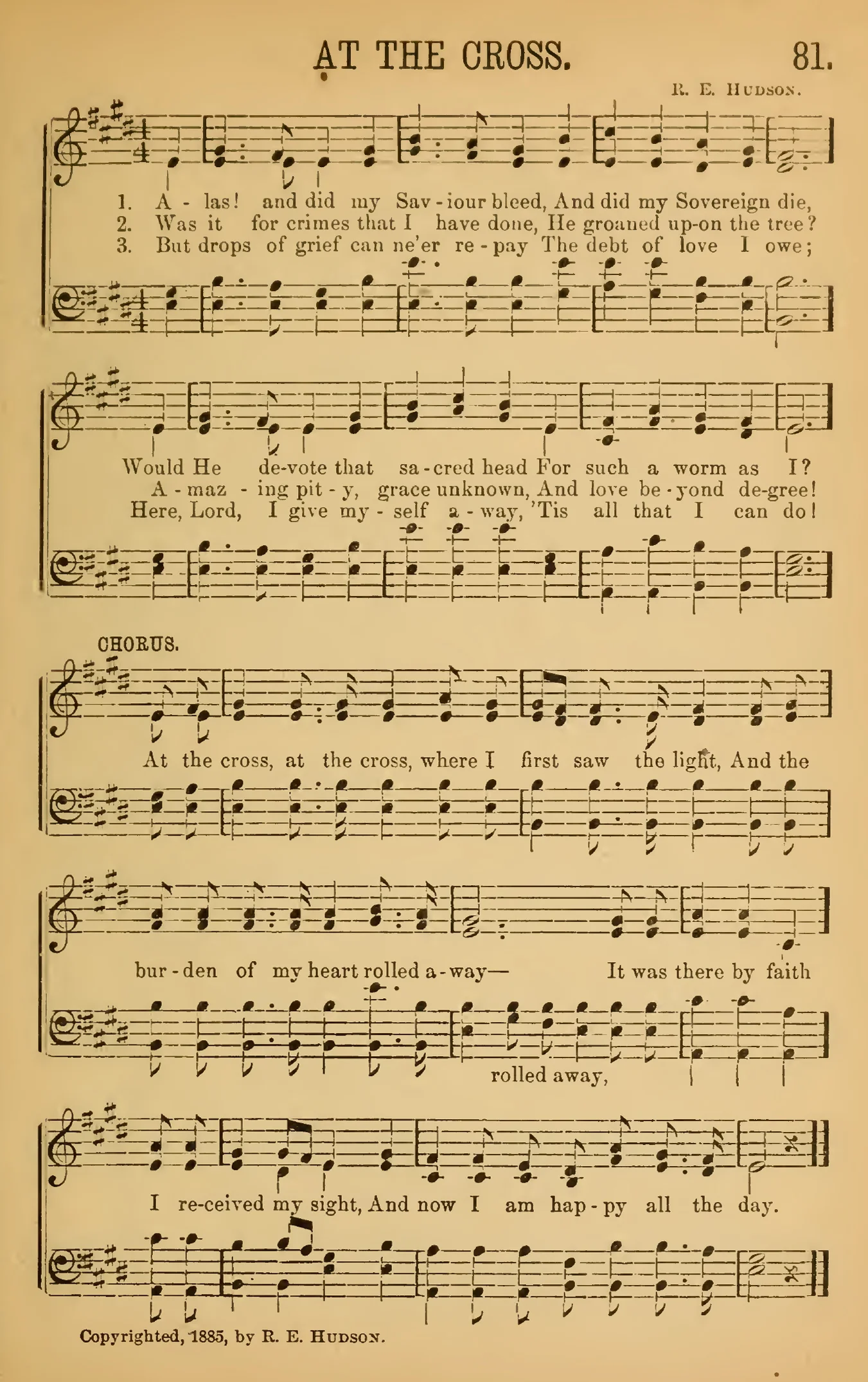
LYRICS:
1 Alas! and did my Savior bleed,
and did my Sovereign die!
Would he devote that sacred head
for sinners such as I?
2 Was it for crimes that I have done,
he groaned upon the tree?
Amazing pity! Grace unknown!
And love beyond degree!
3 Well might the sun in darkness hide,
and shut its glories in,
when God, the mighty maker, died
for his own creature’s sin.
4 Thus might I hide my blushing face
while his dear cross appears;
dissolve my heart in thankfulness,
and melt mine eyes to tears.
5 But drops of tears can ne’er repay
the debt of love I owe.
Here, Lord, I give myself away;
’tis all that I can do.
Why the Hymn Became “At the Cross”
Although Isaac Watts wrote the original text, many churches today know the hymn by its chorus:
“At the cross, at the cross where I first saw the light…”
Interestingly, this refrain was not part of Watts’ original hymn.
The beloved chorus was added in the late nineteenth century by American gospel musician Ralph E. Hudson. Hudson combined Watts’ verses with a joyful gospel refrain, creating the version now sung throughout the world.
The added chorus emphasizes the personal experience of salvation:
- seeing spiritual light
- receiving forgiveness
- laying down guilt
- finding lasting joy through Christ
This beautiful combination allowed the hymn to bridge centuries of Christian worship while preserving its central message.
A Simple Question That Changes Everything
The hymn opens with words that still arrest the heart:
“Alas! and did my Saviour bleed?
And did my Sovereign die?”
Rather than making declarations, Watts begins with questions.
These are not questions seeking information.
They are questions filled with wonder.
How could the perfect Son of God die?
Why would the Holy One suffer for sinful people?
Why would infinite love choose the cross?
Every believer eventually reaches the same place where words fail, and worship begins.
The Cross Reveals Both God’s Justice and God’s Love
The cross is often misunderstood as merely a symbol of suffering.
Scripture reveals something far greater.
At the cross, God’s perfect justice met His perfect mercy.
Sin could not simply be ignored.
Neither could God’s love abandon humanity.
In Jesus Christ, both were fulfilled.
The penalty for sin was paid.
Mercy was offered.
Grace became available to everyone who believes.
This is why Christians throughout history have treasured the cross—not because suffering itself is beautiful, but because love triumphed there.
Grace That Cannot Be Earned
One of the hymn’s most memorable lines asks:
“Would He devote that sacred head for such a worm as I?”
Modern hymnals often replace the word worm with expressions such as sinner or one such as I. While language has changed, the underlying truth remains.
The hymn reminds us that salvation is never something we deserve.
Human achievement cannot purchase forgiveness.
Religious activity cannot erase guilt.
Good intentions cannot overcome sin.
Grace remains entirely a gift.
This message remains remarkably countercultural in every generation because people naturally believe they must earn acceptance.
The Gospel tells a different story.
Christ accomplished what humanity never could.
Tears Alone Are Not Enough
Another verse acknowledges that even our deepest emotions cannot repay Christ’s sacrifice.
No amount of sorrow can earn forgiveness.
No number of tears can purchase grace.
Repentance matters, but repentance itself is not the payment.
Only Jesus could bear that cost.
This truth frees believers from both pride and despair.
We cannot save ourselves.
We do not need to.
Christ already has.
“Love So Amazing, So Divine”
Perhaps the hymn’s greatest legacy is its closing declaration:
“Love so amazing, so divine,
Demands my soul, my life, my all.”
These words summarize the Christian life.
God’s love does not merely ask for Sunday attendance.
It calls for transformed hearts.
Not because we are trying to earn His love.
But because we have already received it.
True worship is always a response.
When believers understand the magnitude of Christ’s sacrifice, surrender becomes an act of gratitude rather than obligation.
Why This Hymn Still Speaks Today
Despite being written more than 300 years ago, At the Cross continues to resonate because the deepest needs of the human heart have not changed.
People still wrestle with guilt.
They still long for forgiveness.
They still search for lasting peace.
They still wonder whether they are truly loved.
Technology has advanced.
Cultures have shifted.
But the human soul still asks the same questions.
The cross continues to offer the same answer.
This is why the hymn remains one of the most enduring expressions of Christian faith.
Its language may come from another century, but its message belongs to every generation.
Biblical Foundations Behind the Hymn
The theology of At the Cross echoes many passages throughout Scripture, including:
- God’s love demonstrated through Christ’s sacrifice.
- The forgiveness made possible by His blood.
- Salvation offered by grace rather than human effort.
- The believer’s response of grateful surrender.
- New life found through the resurrection of Jesus Christ.
Rather than presenting abstract theology, the hymn allows these biblical truths to become personal worship.
How This Hymn Can Shape Daily Faith
Many people reserve this hymn for Easter or communion services.
Yet its message is meant for every ordinary day.
When you feel burdened by guilt, it reminds you that forgiveness has already been provided.
When you struggle with failure, it points back to grace instead of shame.
When pride begins to grow, it humbles the heart before the cross.
When discouragement whispers that God has forgotten you, it reminds you of Calvary—the greatest proof of His love.
Returning to the cross is not moving backward in faith.
It is returning to the very foundation upon which faith stands.
Why Churches Continue to Sing It
Generations come and go.
Musical styles evolve.
New worship songs appear every year.
Yet At the Cross continues to endure because it does something timeless.
It keeps Jesus at the center.
Its focus is not the singer.
Not emotions.
Not personal success.
Not earthly blessings.
Its focus is Christ crucified, risen, and worthy of all praise.
That message never grows old.
About the Hymn
Original Title: Alas! and Did My Saviour Bleed
Common Title: At the Cross
Original Author: Isaac Watts
Original Publication: 1707
Gospel Refrain Added By: Ralph E. Hudson (late 19th century)
Theme: Christ’s atoning sacrifice, grace, redemption, forgiveness, gratitude, worship
Primary Use: Worship services, communion, Easter, personal devotion, prayer, and reflection
Final Reflection
Some songs entertain.
Some inspire.
A few accompany us through life’s changing seasons.
But At the Cross (Alas! and Did My Saviour Bleed) does something even greater.
It gently leads us back to the place where hope was born—not in human strength, but in the sacrificial love of Jesus Christ.
The cross reminds us that our failures do not have the final word.
Our shame does not define us.
Our past is not beyond redemption.
Because at the cross, justice was satisfied, mercy was extended, and love was revealed in its fullest measure.
Centuries after Isaac Watts first penned these words, the hymn continues to invite every listener into the same life-changing response:
To stand in awe.
To receive grace with humility.
And to offer, in return, not merely a song—but our whole lives to the One who gave everything for us.


