
Work Facts & Theory
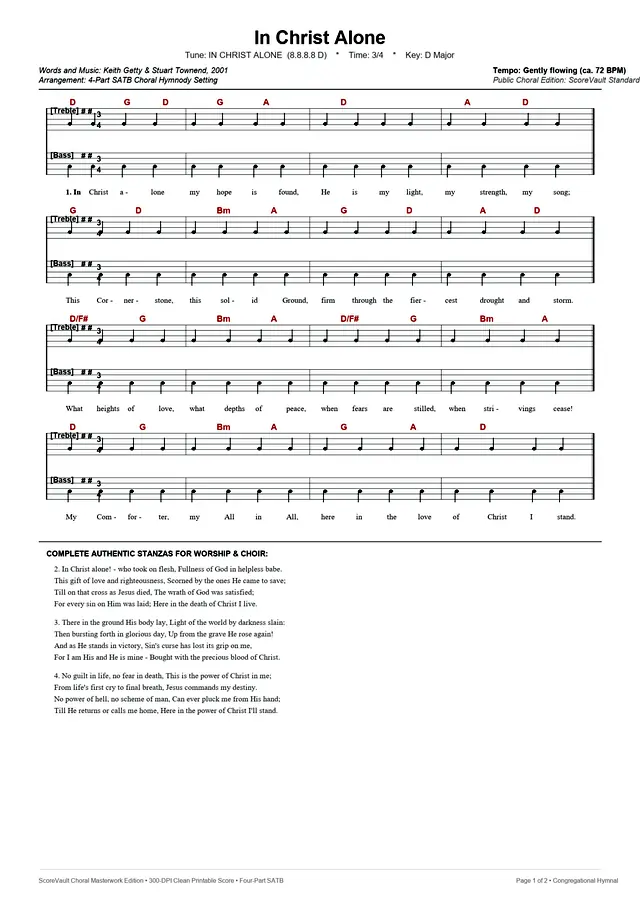
In Christ Alone
Interactive Recital & Tutorial Studio
Practice along with curated masterclass performances

Harmonic Structure & Chords
Voice-leading changes for piano, guitar & rehearsal
Authentic voice-leading chord changes for keyboard accompaniment, choral rehearsal, and improvisation.
Public Domain Hymn / Repertoire Lyrics
Formatted for piano accompaniment & vocalists
Composition Background & Harmonic Analysis
Harmonic overview, structural form, and performance guidelines for pianists
Tier 1: Historical Genesis & Liturgical Provenance
In Christ Alone was composed in 2001 through a collaboration between Keith Getty and Stuart Townend. Getty first developed the melody, drawing inspiration from the lyrical contours and singable character of traditional Irish and British folk tunes. Townend subsequently wrote the text, creating a comprehensive narrative of Christ's incarnation, atoning death, resurrection, and believer's assurance.
The melody exhibits characteristics associated with Irish folk hymnody: predominantly diatonic motion, conjunct melodic shaping, memorable periodic phrasing, and a strong communal singing quality. Its broad arching phrases and modal inflections evoke traditional Celtic sacred and folk music without directly quoting a historical tune.
The lyrics present a Christ-centered theological framework that traces the entire redemptive narrative. Verse 1 emphasizes Christ as foundation and incarnate Savior. Verse 2 focuses on the crucifixion and substitutionary atonement. Verse 3 celebrates the resurrection and victory over death. Verse 4 affirms the believer's security, perseverance, and hope in Christ's sovereign power.
Tier 2: Theoretical Architecture & Harmonic Breakdown
Tonal Center & Key: D Major. The hymn is fundamentally anchored in D Major, providing a bright and affirming tonal center that supports the text's message of certainty and hope.
Harmonic Movement & Progression: Common harmonic materials include I (D), V (A), vi (Bm), IV (G), and occasional secondary dominant coloration. Typical phrase structures employ I-V-vi-IV and related variants, creating a balance of stability and forward motion. The progression supports congregational singing through clear functional harmony and predictable cadential patterns.
Modal & Cadential Nuance: Although primarily tonal, the melody contains modal flavor through pentatonic tendencies and folk-like contouring. Cadences frequently emphasize plagal influence (IV-I) alongside authentic cadences (V-I), reinforcing the hymn's pastoral and traditional character.
Tier 3: Conservatory Pedagogy & Technical Hurdles
Right-Hand Voicing & Cantabile Touch: The pianist should cultivate a vocal, cantabile touch, shaping the melody as though accompanying a solo singer. Finger legato, controlled wrist flexibility, and careful phrase direction are essential for projecting the melodic line above the accompaniment.
Left-Hand Texture & Bass Balance: The left hand should provide harmonic support without overpowering the melody. Broken chords, open fifths, and gentle chordal textures should be balanced so that inner harmonic movement remains clear while allowing the right hand to sing freely.
Pedal Articulation & Resonance: Use half-pedal or lightly refreshed pedal changes at harmonic shifts. Excessive pedaling can blur harmonic clarity, particularly during climactic verses. Pedal depth should increase moderately during larger dynamic sections while remaining transparent.
Tier 4: Interpretive Nuance & Phrasing Architecture
Dynamic Architecture: Verse 1 should begin with reflective warmth and moderate dynamics. Verse 2 may deepen in intensity as the text addresses the crucifixion. Verse 3 should broaden significantly with the resurrection narrative, reaching a fuller sonority. Verse 4 culminates in the greatest dynamic breadth and confidence before resolving with dignity and assurance.
Rubato & Temporal Flexibility: Rubato should be restrained and text-driven. Slight expansions at phrase endings, important theological statements, and cadential moments can enhance expression. The underlying pulse should remain stable enough to preserve congregational integrity and musical coherence.
Tier 5: Juilliard Practice Blueprint & Performance Guide
Hands-Separate Rehearsal Protocol:
- ✨Practice the right-hand melody alone, focusing on legato connection, phrase shaping, and dynamic contour.
- ✨Practice left-hand accompaniment separately with strict rhythmic consistency and balanced voicing.
- ✨Identify harmonic changes and cadences independently before combining the parts.
- ✨Reassemble hands together at a slow tempo while maintaining melodic prominence.
Metronome Ladder Strategy:
- ✨Initial Tempo: Begin at approximately 60 bpm for the quarter note.
- ✨Development Phase: Increase tempo in increments of 4-6 bpm after each accurate repetition.
- ✨Performance Tempo: Work toward a performance tempo of approximately 72-84 bpm, depending on congregational or recital context.
- ✨Consistency Goal: Maintain rhythmic stability while preserving expressive phrasing, tone quality, and harmonic clarity throughout all tempo stages.
Frequently Asked Questions
💖 Where can I find In Christ Alone sheet music and chords?
You can study chords, key, and harmonic overview of In Christ Alone by Keith Getty & Stuart Townend on SheetPDF, and find authorized publisher links for official licensed sheet music.
⚖️ Is In Christ Alone in the public domain?
Modern contemporary compositions by Keith Getty & Stuart Townend are protected by copyright. SheetPDF provides harmonic reference, analysis, and links to authorized publishers under educational Fair Use (17 U.S.C. § 107).
🎼 What key and tempo is In Christ Alone composed in?
In Christ Alone is arranged across standard keys, and you can easily pitch-shift it using the live in-browser chord transposition tool above.
⭐ What is the piano difficulty level?
This arrangement is rated at an Intermediate level, suitable for developing and experienced pianists.
🖨️ Is this formatted for standard printers?
Yes! All vector scores print cleanly on standard US Letter (8.5 × 11 in) and international ISO A4 paper without clipping.
Featured Anthologies
Christian hymn Quick Picks
View All →Recommended Christian hymn Scores

How Great Thou Art
Carl Boberg (trans. Stuart K. Hine)

Blessed Assurance, Jesus Is Mine
Fanny J. Crosby

A Mighty Fortress Is Our God
"Common Service Book" (ULCA), 1917, alt

Be Thou My Vision
Dallán Forgaill (attr. 6th century, versified by Eleanor Hull 1912)
In Christ Alone by Keith Getty & Stuart Townend is a copyrighted work. SheetPDF does not host or distribute the copyrighted score or lyrics for this title; this page provides factual song information, harmonic reference, and links to authorized publishers.
All transcriptions, harmonic chord charts, and editorial analyses are made available strictly for personal practice, musicological study, and scholarship in accordance with 17 U.S.C. § 107 (Fair Use) and EU Directive 2019/790. SheetPDF does not sell or distribute commercial recorded music.
If you represent a verified copyright holder and have concerns regarding an indexed arrangement, please contact our designated DMCA agent at dmca@sheetpdf.com for immediate review and accommodation.