
Score Preview (Page 1 of 2)
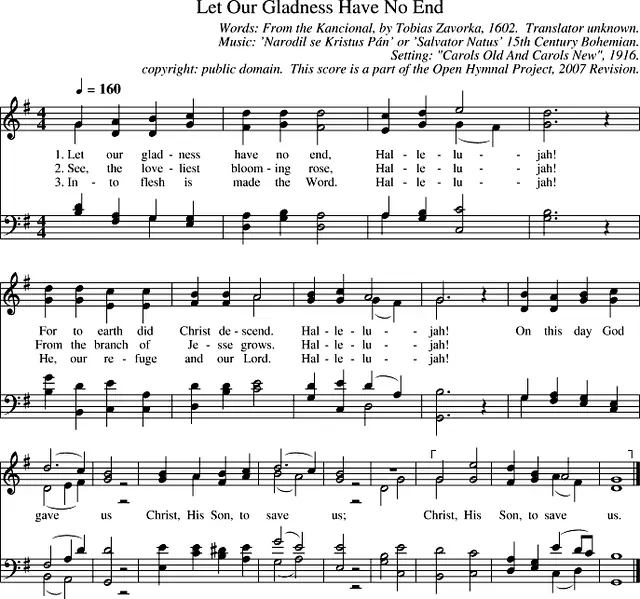
Let Our Gladness Have No End
Interactive Recital & Tutorial Studio
Practice along with curated masterclass performances
Musicological Analysis & Practice Blueprint
Conservatory study covering harmonic architecture, articulation, and practice touch
Temporal Flow & Metronomic Guidance
Operating within 2/4, this simple duple meter generates an energetic duple meter that contrasts accented downbeats with buoyant upbeats. The benchmark tempo of ♩ = 112 BPM (Animato) conveys a cheerful with buoyant rhythmic bounce sensibility. During execution, maintain a light physical lift on the unaccented half of the measure.
Historical Background & Scholarly Metadata
Attributed to "Carols Old And Carols New", 1916, Let Our Gladness Have No End forms an integral entry in the contemporary holiday piano repertory. Laid out across 2 pages containing 48 measures, this score draws authenticity from verified performance editions and modern engravings. Work tracking associates this edition with ISWC identifier `T-233.1F2.2B-1` and registry `mbid-2331f22b-sheetpdf`. Contextual research indicates: This Christmas carol originates from a 15th century Bohemian melody known as 'Narodil Se Kristus Pán.' Its inclusion in early 20th century hymn collections such as Carols Old And C.
Keyboard Technique & Practice Directives
Positioned within the Easy repertoire (foundation study curriculum (RCM Level 1–2)), this work offers valuable training in balance and tone. Performers must concentrate on balancing quiet accompaniment figures beneath a clearly audible melodic statement. Navigating flowing keyboard arpeggios that support emotional melodic peaks asks for deliberate finger weight distribution. To preserve clarity, feather the pedal to sustain bass notes without drowning upper textures. Technical Drill: count subdivisions out loud during practice to stabilize tempo and prevent rushing. Score pointer: Maintain a buoyant dance-like pulse reflecting the Bohemian carol origin, with light detached bass notes and singing treble lines. Bring out the refrain through.
Harmonic Blueprint & Structural Progressions
Anchored in F Major, this work utilizes a key signature of one flat (B♭). The composer builds structural coherence around F, deploying the relative pole (D Minor) to introduce tonal contrast before resolving through C Major. Voice leading proceeds primarily through diatonic harmonic motion involving tonic, subdominant, and dominant degrees. Under the fingers, F Major features an expansive keyboard color historically prized for tranquil, pastoral cantabile expressions.
Repertoire Scope & Transposition Reference
When programming this selection, music educators frequently schedule Let Our Gladness Have No End for contemporary vocal accompaniment, student recitals, and studio recordings. Adapting the original F Major setting is straightforward: lower tessituras find comfort in E-flat Major, whereas soprano instruments or solo flutes achieve singing resonance in G Major. From an attribution perspective: This title stands in the global public domain, enabling unhindered study, liturgical execution, and recital programming.
Frequently Asked Questions
💖 Where can I find Let Our Gladness Have No End sheet music and chords?
You can study and view the complete 2-page printable A4 vector score of Let Our Gladness Have No End directly in the open archive on SheetPDF. High-resolution folio viewer, interactive chords, and MIDI audio reference are also provided.
⚖️ Is Let Our Gladness Have No End in the public domain?
Modern contemporary compositions by "Carols Old And Carols New", 1916 are protected by copyright. SheetPDF provides harmonic reference, analysis, and links to authorized publishers under educational Fair Use (17 U.S.C. § 107).
🎼 What key and tempo is Let Our Gladness Have No End composed in?
Let Our Gladness Have No End is arranged across standard keys, and you can easily pitch-shift it using the live in-browser chord transposition tool above.
⭐ What is the piano difficulty level?
This arrangement is rated at an Easy level, suitable for developing and experienced pianists.
🖨️ Is this formatted for standard printers?
Yes! All vector scores print cleanly on standard US Letter (8.5 × 11 in) and international ISO A4 paper without clipping.
Featured Anthologies
Johann Pachelbel Sacred Choral Transcriptions Piano Collection (Printable PDF)
200 ScoresLudwig van Beethoven Preludes & Impromptus Piano Collection (Printable PDF)
200 ScoresLudwig van Beethoven Sacred Choral Transcriptions Piano Collection (Printable PDF)
200 ScoresClaude Debussy Sacred Choral Transcriptions Piano Collection (Printable PDF)
200 ScoresHoliday Quick Picks
View All →Recommended Holiday Scores

Joy to the World! The Lord Is Come
Isaac Watts

Hark! The Herald Angels Sing
Charles Wesley (alt. George Whitefield)

Silent Night, Holy Night
Joseph Mohr (trans. John F. Young)

Joy to the World
George Frideric Handel & Isaac Watts
SheetPDF functions as an academic score indexing repository and digital music folio reader. Historical compositions by master composers and traditional church hymns are documented as part of the worldwide musical public domain (free of known copyright restrictions under US Copyright Law and the Berne Convention).
All transcriptions, harmonic chord charts, and editorial analyses are made available strictly for personal practice, musicological study, and scholarship in accordance with 17 U.S.C. § 107 (Fair Use) and EU Directive 2019/790. SheetPDF does not sell or distribute commercial recorded music.
If you represent a verified copyright holder and have concerns regarding an indexed arrangement, please contact our designated DMCA agent at dmca@sheetpdf.com for immediate review and accommodation.