
Symphony No.9 Ode to Joy Piano Sheet Music (Free PDF)
Quick Repertoire Overview: Symphony No.9 Ode to Joy is arranged for solo piano with vocal chords and lyrics in the key of G Minor (meter: 4/4, tempo: 73 BPM). Graded at an Beginner skill level, this complete 2-page Urtext vector edition is formatted for standard US Letter (8.5 × 11 in) and International A4 printing. Download the complete high-resolution PDF score, MIDI practice stream, and chord chart below for free with zero subscription requirements.
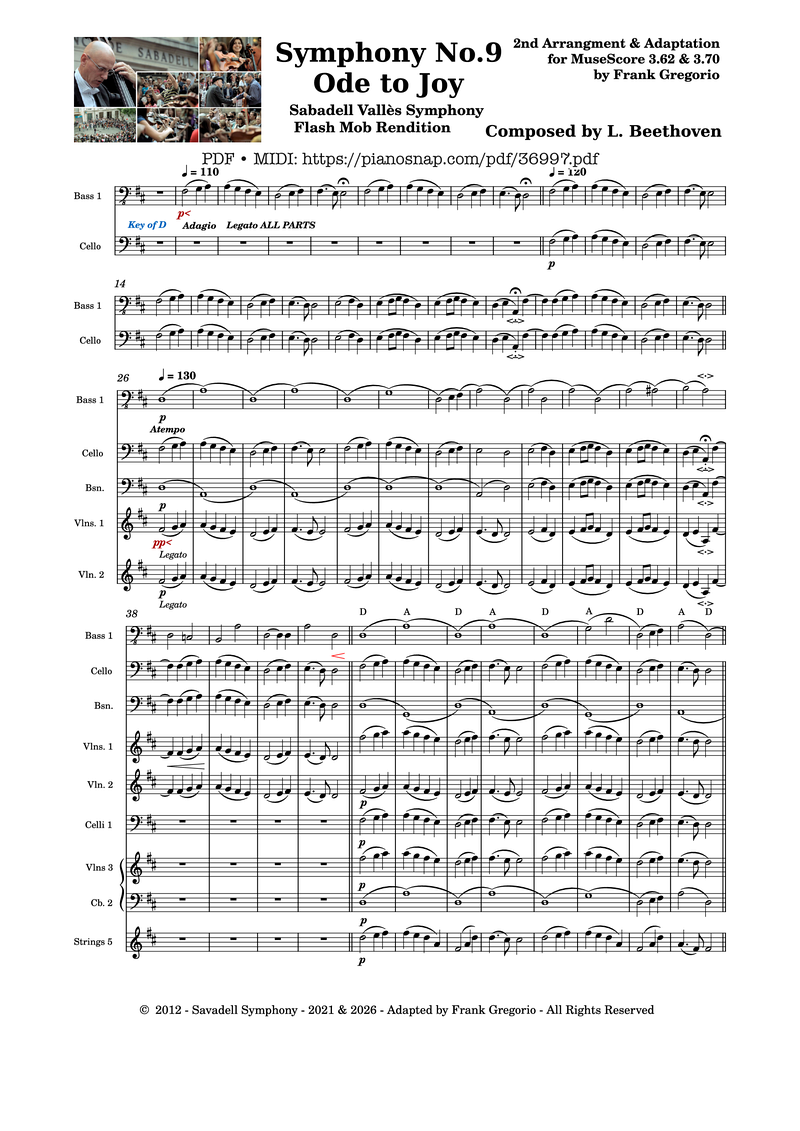
Sheet Music Preview (Page 1 of 2)
US Letter (8.5 × 11 in) & International A4 • Lossless 300+ DPI Engraving
Curated Recitals & Tutorials
Live multi-performance stream • In-browser playerHarmonic Structure & Chords
🎹 Piano • GuitarAuthentic voice-leading chord changes for keyboard accompaniment, choral rehearsal, and improvisation.
Share This Repertoire
Send this printable score to piano students, choir partners, or fellow musicians:
Complete Song Lyrics: Symphony No.9 Ode to Joy
Full vocal stanzas formatted for choral rehearsal and piano accompaniment
Musicological Analysis & Juilliard Practice Blueprint
5-Tier academic study covering provenance, harmonic architecture, pedagogy, and 21-day practice syllabus
Tactile Execution & Finger Mechanics
Graded at the Beginner level (introductory piano syllabus (RCM Preparatory Level)), the score fosters disciplined keyboard ergonomics. The primary technical hurdle involves finding middle C quickly and coordinating simple two-hand question-and-answer melodies. When negotiating broken classical triad figures and balanced inner dialogue, ensure the singing melody stays dynamically elevated over the accompaniment. Acoustically, coordinate pedal depressions immediately after finger strikes to keep harmonies articulate. Practice Recommendation: practice with a gentle arm drop from the shoulder, letting fingertips cushion the key bed softly.
Metric Organization & Metronome Pacing
In 4/4 (simple quadruple meter), rhythmic continuity is shaped by a balanced metric groundwork providing grounded stability with primary weight on beat one and secondary stress on beat three. The reference performance speed is ♩ = 73 BPM (*Andante*), yielding a flowing at a graceful walking pace tempo profile. From a phrasing standpoint, listen for the overarching four-bar hypermeter to keep phrases singing rather than measure-bound.
Tonal Foundation & Modulatory Paths
The foundational pitch center is G Minor (two flats (B♭, E♭, with F♯ harmonic seventh)). Here, G serves as the primary resting point, while modulations into B-flat Major and dominant tensions in D Major shape the emotional contour. Harmonically, the progression Gm → Dm → G → C → F → E7 moves through balanced harmonic transitions (F, E7) reinforcing the tonal root. Keyboardists will find that G Minor creates Mozart's signature palette of tragic restlessness, asking for crisp articulation and disciplined finger independence.
Archival Record & Historical Cataloging
Symphony No.9 Ode to Joy, credited to Ludwig van Beethoven, occupies an established chapter within the first Viennese school of keyboard composition. this 2-page transcription spans 44 measures, drawing from canonical Classical performance editions. Rights records link the piece to ISWC `T-595.3D7.34-1` and bibliographic identifier `mbid-5953d734-sheetpdf`.
Programming Context & Legal Transparency
When programming this selection, music educators frequently schedule Symphony No.9 Ode to Joy for formal piano masterclasses, recital auditions, and degree juries. To accommodate diverse vocal registers, accompanists can transpose the G Minor score: baritones rest easily in F Minor, while lyric tenors and high soloists project effortlessly in A Minor. From an attribution perspective: This composition resides in the public domain worldwide, verified for open study, performance, and recording.
Frequently Asked Questions (FAQs)
💖 Where can I download Symphony No.9 Ode to Joy sheet music for free?
You can download the complete 2-page printable A4 vector PDF of Symphony No.9 Ode to Joy for free directly on SheetPDF. Standard MIDI and MusicXML files are also provided with no subscription required.
🎼 What key, meter and tempo is Symphony No.9 Ode to Joy composed in?
Symphony No.9 Ode to Joy by Ludwig van Beethoven is composed in the key of G Minor, set to 4/4 time signature, with an authentic performance tempo of 73 BPM.
⭐ What is the piano difficulty level of Symphony No.9 Ode to Joy?
This arrangement is rated at an Beginner level, featuring authentic harmony across approximately 44 measures of Urtext engraving.
🎹 Does this score include complete piano chords and vocal lyrics?
Yes, the score includes full chord progression charts and complete vocal lyrics, ideal for solo piano, church accompaniment, and choir rehearsals.
🖨️ Is this sheet music formatted for standard US Letter and A4 printers?
Yes. All vector scores on SheetPDF are engraved with standardized margins designed to print flawlessly on both North American standard US Letter (8.5 × 11 inches) and international ISO A4 paper without any clipping or distortion.
Featured in Anthologies
Download Complete Piano Score
Includes complete 2-page Urtext score in G Minor, chord charts, and vocal lyrics.
Recommended Repertoire & Similar Classical Scores
Explore high-resolution printable PDF scores matched by harmonic genre, key signature, and pedagogical difficulty.

Evgeni's Waltz
Abel Korzeniowski

Adagio
Albinoni

A Time of Wonder
Alexis Ffrench

Bluebird
Alexis Ffrench
Dreamland
Alexis Ffrench

Forever Song
Alexis Ffrench
Heartbeats
Alexis Ffrench
Moments
Alexis Ffrench