

The Battle Hymn of the Republic
▶️ Don't miss this Song of the Day ◀️
Few hymns carry the same combination of majesty, solemnity, and emotional power as “The Battle Hymn of the Republic.” From its opening declaration—“Mine eyes have seen the glory of the coming of the Lord”—the hymn sounds both like a prayer and a proclamation. Its unforgettable refrain, “Glory, glory, hallelujah! His truth is marching on,” has been sung in churches, at memorial services, patriotic ceremonies, military gatherings, and moments when people have needed courage and hope.
For many older hymn lovers, this is more than a historic song. It is part of the soundtrack of American faith and memory. Its strong melody may recall church services from childhood, school assemblies, family gatherings, or solemn national occasions. Yet behind the familiar tune is a remarkable story involving the American Civil War, the abolitionist movement, biblical poetry, and a woman whose words transformed a popular marching song into one of the nation’s most enduring hymns.
At a Glance
|
Detail
|
Information
|
|
Common title
|
“The Battle Hymn of the Republic”
|
|
Lyrics
|
Julia Ward Howe
|
|
Lyrics written
|
November 1861
|
|
First published
|
The Atlantic Monthly, February 1862
|
|
Original melody
|
Associated with William Steffe’s mid-nineteenth-century tune
|
|
Earlier song
|
“Say, Brothers, Will You Meet Us?”
|
|
Popular Civil War version
|
“John Brown’s Body”
|
|
Historical setting
|
The American Civil War and the struggle to end slavery
|
|
Central message
|
God’s justice is active, moral truth will prevail, and freedom requires faithful action
|
What Is “The Battle Hymn of the Republic” About?
At its heart, the hymn is about divine justice moving through human history. It presents God not as distant or passive, but as One who sees injustice, judges evil, and calls people to answer with courage. The repeated declaration that “His truth is marching on” expresses confidence that falsehood and oppression will not have the final word.
The hymn was written during the Civil War, when the United States was divided over secession, slavery, national authority, and the future of freedom. Julia Ward Howe wrote from the perspective of a committed abolitionist. Her words therefore carry both spiritual and historical meaning. They speak of Christ, judgment, sacrifice, freedom, and the moral responsibility of those who believe they are serving a righteous cause.
The song is not a light or casual expression of patriotism. It is a serious meditation on the cost of justice. The line “As He died to make men holy, let us die to make men free” connects Christian sacrifice with the painful work of liberation. In its original setting, the hymn asked listeners to consider whether they were willing to give themselves for a freedom that was more than political independence—a freedom that confronted slavery and human bondage.
The Story Behind the Melody
The melody was already well known before Julia Ward Howe wrote her words. The tune had been associated with a Methodist camp-meeting song titled “Say, Brothers, Will You Meet Us?” and is generally credited to William Steffe, whose tune dates from about 1856. The song circulated widely, especially around Charleston, South Carolina, including among free Black congregations and Methodist communities. The Library of Congress notes that the tune and early lyrics existed in several forms before the Civil War.
The melody’s simple, repetitive structure made it easy to remember and easy to sing in a group. It could be adapted to new words, which was common in nineteenth-century religious and political song. Its steady rhythm also made it suitable for marching.
After the raid on Harpers Ferry led by the abolitionist John Brown in October 1859, new lyrics began to appear. John Brown was captured, tried, and executed, and many antislavery supporters came to regard him as a martyr. The familiar song was adapted into “John Brown’s Body,” with words about Brown’s body lying in the grave while “his soul is marching on.”
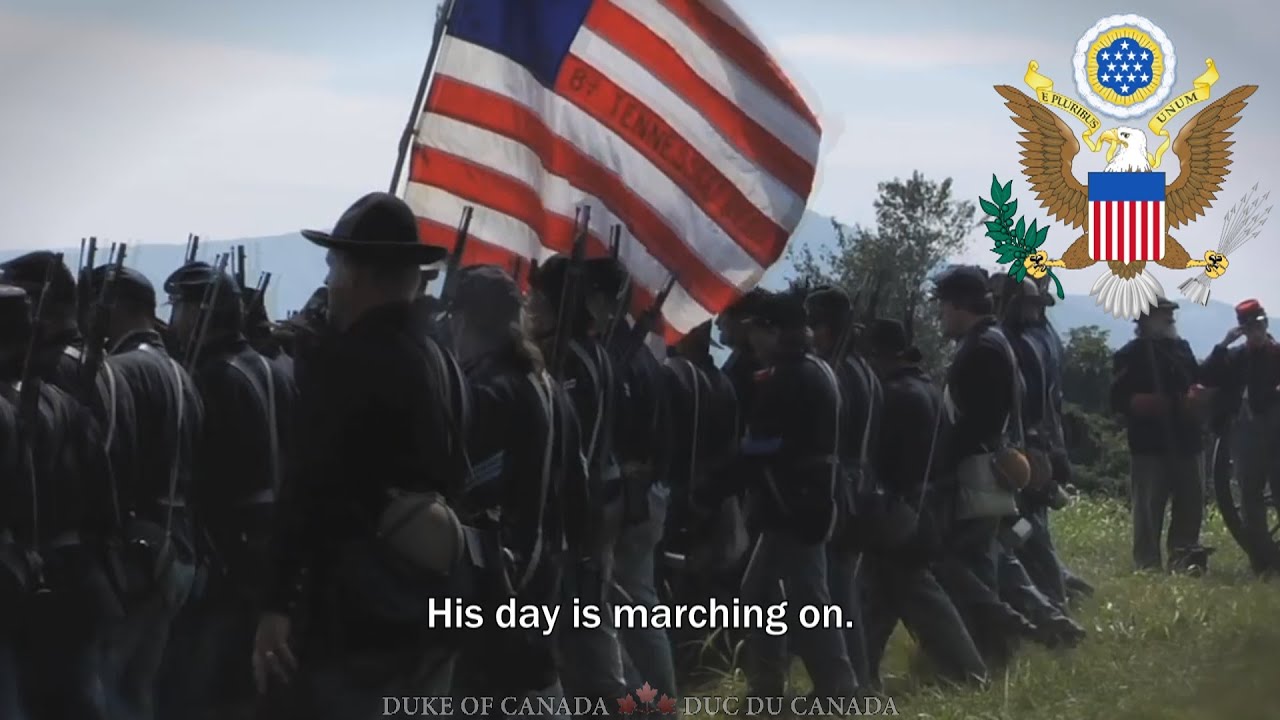
By the opening years of the Civil War, Union soldiers were singing “John Brown’s Body” as a marching song. The tune’s history is therefore more complicated than the image of a single patriotic composition. It moved through Black religious communities, camp meetings, army camps, abolitionist circles, and wartime popular culture before Julia Ward Howe gave it its most famous words.

Julia Ward Howe and the Birth of the Hymn
Julia Ward Howe was a writer, poet, abolitionist, lecturer, and later an advocate for women’s rights. Born in New York City in 1819, she came from a financially comfortable family but used her public voice to address major moral and social questions. Her husband, Samuel Gridley Howe, was also a prominent abolitionist and reformer.
In November 1861, Julia Ward Howe visited Washington, D.C., with her husband and the Reverend James Freeman Clarke. During the visit, she observed Union troops and heard them singing “John Brown’s Body.” According to the account preserved by the American Battlefield Trust, Reverend Clarke suggested that Howe write new words for the familiar tune. Howe replied that she had often thought of doing so.
The next morning, she woke before dawn with the words forming in her mind. In her later recollection, she remained still until the poem had taken shape, then hurried to write it down before she forgot it. The experience became one of the most famous stories in American hymn history: a familiar marching tune receiving a new poem in a moment of intense inspiration.
Howe’s poem was published on the front page of The Atlantic Monthly in February 1862. The magazine’s editor, James T. Fields, is widely credited with giving the poem the title “The Battle Hymn of the Republic.” The poem was reportedly purchased for five dollars, but its influence would eventually extend far beyond the value of its original payment.
The Biblical Language of the Hymn
One reason the hymn has endured is its rich biblical imagery. Howe did not simply write a wartime song. She created a poem that draws on Scripture and asks the listener to interpret the war through a moral and theological lens.
“Mine eyes have seen the glory of the coming of the Lord”
The opening line announces a vision. The speaker is not merely reporting what can be seen with ordinary eyes. The speaker claims to perceive God’s presence and purpose within a troubled historical moment. The phrase “the coming of the Lord” suggests divine intervention, judgment, and the fulfillment of God’s moral order.
“The grapes of wrath are stored”
The image of the grapes of wrath comes from the biblical language of judgment, particularly the imagery of the winepress in Revelation. The metaphor suggests that evil has reached a point at which it must be confronted. The hymn’s “vintage” is not a celebration of harvest. It is an image of accumulated wrongdoing brought under divine judgment.
“His terrible swift sword”
The sword represents the decisiveness of divine justice. It also reflects the violence of the Civil War, when moral conviction and physical conflict were inseparably connected. The line is powerful because it does not pretend that justice is painless. It asks the listener to face the seriousness of evil and the consequences of confronting it.
“As ye deal with my contemners, so with you my grace shall deal”
This verse presents a moral principle: people should expect to be judged according to how they treat those they despise or oppress. The line echoes the biblical teaching that human conduct has consequences before God. It also turns the hymn toward the issue of slavery, because the freedom of some Americans depended on the forced labor and suffering of others.
“Let us die to make men free”
This is among the hymn’s most demanding lines. It does not glorify death for its own sake. Instead, it connects the self-giving love associated with Christ’s death to the sacrifice required to end slavery and defend freedom. For nineteenth-century listeners, the line had an immediate wartime meaning. For later generations, it has continued to raise questions about service, moral courage, and the responsibilities of citizenship.
Why the Hymn Became So Powerful During the Civil War
The hymn gave the Union cause a language of moral purpose. It did not describe the conflict as merely a disagreement between political regions. It framed the struggle as a test of justice and human freedom.
That framing helped explain why the song spread so quickly. Soldiers needed music that could maintain courage during exhausting marches and frightening battles. Families needed words that could give meaning to sacrifice. Abolitionists needed a public expression of their conviction that slavery was not only politically wrong but morally evil.
The hymn’s melody also contributed to its success. Its broad, rising phrases are easy for a congregation or large crowd to sing. The repeated “Glory, glory, hallelujah” creates a feeling of shared strength. Even when people cannot remember every verse, they can usually join the refrain. This makes the hymn both personal and communal: one person may sing it quietly as a prayer, while thousands can sing it together as a declaration.
The Library of Congress records that the song was especially popular among Union regiments and Colored troops. It also notes that Confederate singers sometimes altered the words to reflect their own cause, showing how recognizable and contested the melody had become.
The Meaning of “His Truth Is Marching On”
The phrase “His truth is marching on” is the spiritual center of the hymn. It expresses a faith that truth is not static. Truth moves forward, confronts falsehood, and becomes visible through the actions of people who respond to God’s call.
For Christian listeners, the phrase can mean that God’s purposes continue despite war, grief, injustice, and human failure. For many Americans, it has also become a broader statement about moral progress: the belief that a nation can be called to become more faithful to the principles of freedom and human dignity.
The line should not be understood as a promise that history will always move smoothly or quickly. The hymn was written during a period of extraordinary suffering. Its confidence is not based on the absence of tragedy. Instead, it declares that tragedy does not cancel God’s justice.
That is part of the reason older listeners often find the hymn especially meaningful. A person who has lived through decades of family changes, national crises, wars, losses, and answered prayers may hear the words differently from someone encountering them for the first time. The hymn’s hope is mature hope. It does not deny sorrow. It insists that sorrow is not the final chapter.
The Difference Between the Original Poem and Common Performances
Many modern performances use a familiar chorus:
Glory, glory, hallelujah!
Glory, glory, hallelujah!
Glory, glory, hallelujah!
His truth is marching on.
The chorus is deeply associated with the hymn and is often included in church hymnals, concerts, and patriotic programs. However, the original poem published in The Atlantic Monthly in 1862 appeared as a series of five stanzas without the modern refrain printed between them.
This distinction does not diminish the chorus. It shows how hymns evolve as communities sing them. Congregations, soldiers, arrangers, and later generations helped shape the version that became familiar. The repeated refrain gives the song a strong congregational form and reinforces its central message.
The image accompanying this article presents the hymn in a dramatic American setting, combining lightning, a cross, wheat fields, soldiers, and the flag. These symbols capture several themes associated with the song: judgment, faith, sacrifice, harvest, national struggle, and hope. The artwork is a modern interpretation rather than a historical scene from the hymn’s original publication, but it reflects the emotional scale on which the song is often remembered.
Julia Ward Howe’s Legacy Beyond the Hymn
Although “The Battle Hymn of the Republic” became Julia Ward Howe’s most famous work, it was only one part of her life. After the Civil War, she remained active in reform movements, including women’s suffrage and peace advocacy. She helped found organizations that supported women’s public participation and continued to lecture and write.
Her life is important because it demonstrates that the hymn was not an isolated burst of inspiration from someone who disappeared from public affairs. Howe was part of a larger reform tradition. She believed that literature, religion, public speech, and civic action could work together to challenge injustice.
Her authorship also matters historically because women’s voices were often excluded from public leadership in the nineteenth century. Yet one of the most recognizable American songs associated with national purpose and moral courage came from a woman poet whose words entered the lives of soldiers, congregations, presidents, and generations of families.
How the Hymn Is Used Today
“The Battle Hymn of the Republic” continues to appear in settings that call for solemnity, courage, and unity. It may be heard at Memorial Day programs, Veterans Day ceremonies, funerals, presidential occasions, church services, historical commemorations, and concerts of American sacred music.
Its meaning can change according to the setting. In church, it may sound like a hymn of judgment and redemption. At a memorial service, it may express grief joined with hope. At a civic ceremony, it may call a nation to live more faithfully by its ideals. At a family gathering, it may simply awaken memories of voices singing together across generations.
Because the hymn is connected to the Civil War and the history of slavery, it should be performed with awareness of that difficult context. Its message of freedom is strongest when listeners remember the people whose suffering made the question of freedom unavoidable. The song is not only about victory. It is about the moral cost of injustice and the responsibility to pursue a more just society.
Why Older Hymn Lovers Still Treasure It
For older generations, the hymn often carries a personal history that cannot be found in a textbook. It may recall a parent’s favorite song, an elementary-school music program, a church choir, a military funeral, or a holiday service. The first notes can bring back not only a melody but also a place, a face, and a time of life.
The hymn also respects the seriousness of faith. It does not offer shallow encouragement. It speaks about judgment, sacrifice, freedom, and responsibility. At the same time, it gives the listener a clear and memorable promise: God’s truth continues to move forward.
That promise remains meaningful in every generation. People still face division, fear, injustice, and uncertainty. They still need the courage to believe that goodness is worth defending. They still need the humility to ask whether their own actions serve justice. And they still need songs that allow them to stand together when ordinary words feel inadequate.
Final Reflection
“The Battle Hymn of the Republic” has survived for more than a century and a half because it joins a memorable melody to a profound moral vision. Julia Ward Howe took a popular marching tune and gave it words that transformed it into a hymn of judgment, freedom, sacrifice, and hope.
Its history reaches from Methodist camp meetings and Black religious communities to Civil War regiments and modern churches. Its language draws from Scripture, but its questions remain human and immediate: What does justice require? What are we willing to sacrifice for freedom? How should people of faith respond when the world is broken?
When we sing, “His truth is marching on,” we are not claiming that the road is easy. We are affirming that truth, justice, and God’s purposes can continue moving forward even through darkness. That is why the hymn still speaks so powerfully to the heart—and why its glory has not faded.