


All Things Bright And Beautiful
▶️ Don't miss this Song of the Day ◀️
The Timeless Hymn That Celebrates God’s Wonderful Creation
Few hymns capture the beauty of God’s creation as joyfully as All Things Bright and Beautiful. For nearly two centuries, this beloved hymn has invited Christians of all ages to pause, look around, and recognize the fingerprints of the Creator in every flower, bird, mountain, and sunrise.
Often introduced as a children’s hymn because of its simple language and memorable melody, it carries a much deeper message than many people realize. Beneath its cheerful verses is a profound reminder that the natural world is not merely a collection of beautiful landscapes—it is a living testimony to God’s wisdom, creativity, and sustaining power.
The Story Behind the Hymn
The words of All Things Bright and Beautiful were written in 1848 by Cecil Frances Alexander (1818–1895), one of the most influential hymn writers of the Victorian era.
Born in Dublin, Ireland, Alexander devoted much of her life to teaching children the Christian faith. She believed that theology should not remain confined to scholars and clergy but should be understandable to ordinary families and especially to young believers.
The hymn first appeared in her collection Hymns for Little Children, a book created to help explain the Apostles’ Creed through simple, memorable songs. While the language was accessible for children, Alexander carefully rooted every hymn in biblical truth, allowing readers of every age to grow in their understanding of God.
The melody most commonly associated with the hymn today was composed later by William Henry Monk in 1887. His uplifting tune helped transform the hymn into one of the best-known pieces of Christian music in the English-speaking world.

Lyrics:
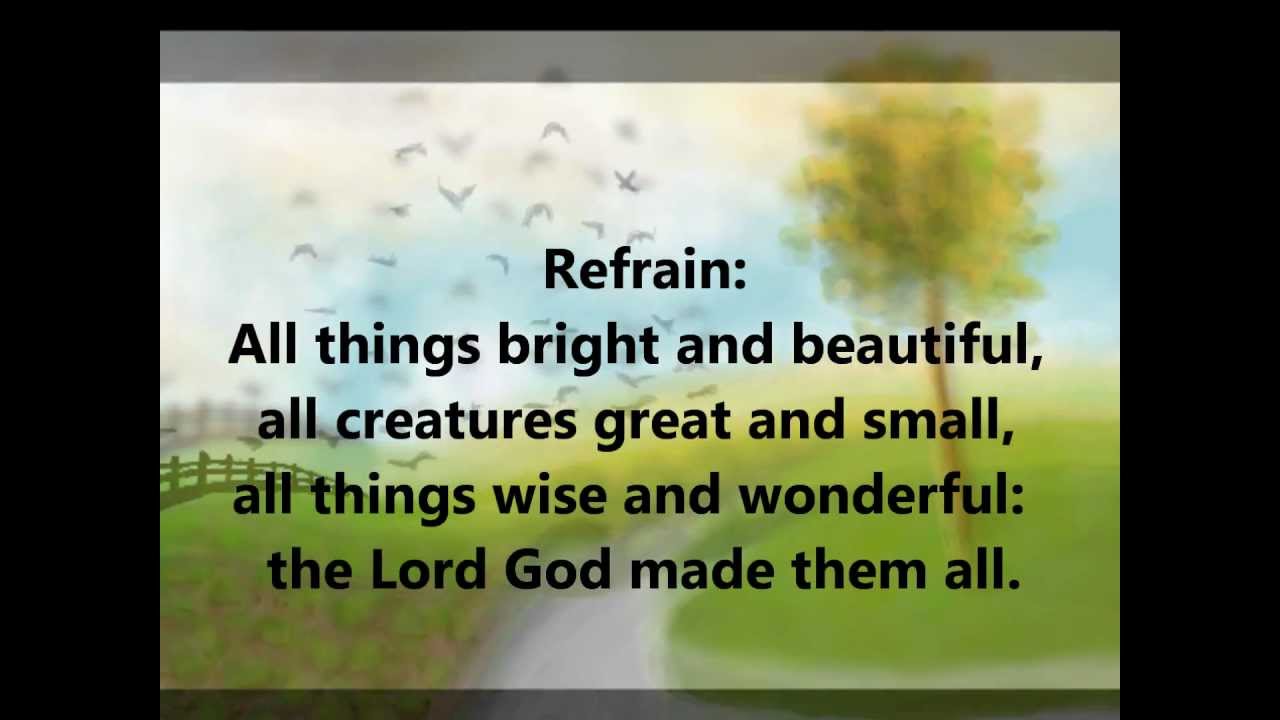
Refrain:
All things bright and beautiful,
all creatures great and small,
all things wise and wonderful,
the Lord God made them all.
1 Each little flow’r that opens,
each little bird that sings,
He made their glowing colors,
He made their tiny wings. [Refrain]
2 The purple-headed mountain,
the river running by,
the sunset and the morning
that brightens up the sky. [Refrain]
3 The cold wind in the winter,
the pleasant summer sun,
the ripe fruits in the garden:
He made them every one. [Refrain]
4 He gave us eyes to see them,
and lips that we might tell
how great is God Almighty,
who has made all things well. [Refrain]
Inspired by the Opening Pages of the Bible
The hymn draws its inspiration primarily from the creation account in the Book of Genesis.
After creating the heavens and the earth, God looked upon His work and declared that it was “very good.” Every part of creation, from the smallest flower to the highest mountain, reflected His wisdom and purpose.
The hymn also echoes the words of Psalm 19:1:
“The heavens declare the glory of God; the skies proclaim the work of his hands.”
Another important biblical connection comes from Psalm 104, where creation is described as a continual display of God’s provision and care for every living creature.
Rather than viewing nature as existing independently, the hymn reminds believers that every beautiful thing ultimately points back to its Creator.
More Than a Children’s Song
Because it is frequently taught in Sunday schools, many people assume All Things Bright and Beautiful is simply a hymn for children.
In reality, it expresses one of Christianity’s oldest and most important theological themes: creation reveals the character of God.
Every colorful flower demonstrates His creativity.
Every changing season reflects His faithfulness.
Every sunrise reminds us of His mercy.
Every bird’s song becomes another voice in creation’s ongoing praise of its Maker.
The hymn encourages believers to develop a sense of wonder that often disappears as people grow older and become occupied with daily responsibilities.
The Meaning Hidden in Everyday Beauty
One of the hymn’s greatest strengths is that it teaches believers to notice what they might otherwise overlook.
A child picking up a wildflower.
Morning sunlight shining through the trees.
Snow quietly covering the landscape.
The sound of birds greeting a new day.
These ordinary experiences become extraordinary when viewed through the eyes of faith.
The hymn reminds Christians that God’s presence is often recognized not only through dramatic miracles but also through the quiet beauty woven into everyday life.
It encourages gratitude rather than taking creation for granted.
A Hymn That Inspires Stewardship
Another reason the hymn continues to resonate today is its relevance to conversations about caring for the natural world.
Long before environmental stewardship became a widely discussed topic, All Things Bright and Beautiful encouraged believers to appreciate God’s creation as something precious rather than disposable.
The hymn does not worship nature.
Instead, it teaches that because creation belongs to God, it deserves respect and responsible care.
For many Christians, this perspective has inspired a deeper appreciation for conservation, responsible stewardship, and gratitude for the earth’s resources without losing sight of the Creator Himself.
A Global Legacy
Over the past 175 years, All Things Bright and Beautiful has become one of the most recognized English-language hymns in the world.
It has been translated into numerous languages and appears in hymnals across many Christian traditions, including Anglican, Methodist, Presbyterian, Lutheran, and other Protestant denominations.
The hymn is regularly sung during harvest festivals, creation-themed worship services, school assemblies, Easter celebrations, and family gatherings.
Its enduring popularity comes not only from its beautiful melody but also from its universal message. Regardless of where people live, they can look at the world around them and find reminders of God’s handiwork.
Why the Hymn Still Matters Today
Modern life often keeps people indoors, surrounded by screens, schedules, and constant distractions. In the rush of everyday responsibilities, it becomes easy to overlook the beauty that surrounds us.
All Things Bright and Beautiful gently calls believers to slow down.
It invites them to notice the changing colors of the seasons, the songs of birds in the morning, the brilliance of the night sky, and the countless details that reveal God’s creativity.
The hymn also challenges a culture that often values possessions more than wonder. It reminds Christians that some of God’s greatest gifts cannot be bought or manufactured. They are freely displayed every day through His creation.
A Legacy That Continues Across Generations
Nearly two centuries after Cecil Frances Alexander first penned its words, All Things Bright and Beautiful continues to unite generations in worship.
Children sing it with delight because of its joyful melody.
Adults return to it because its message grows richer with experience.
Older believers often find new meaning in its words after a lifetime of witnessing God’s faithfulness through changing seasons.
Its lasting influence demonstrates that great hymns are more than musical compositions. They become teachers of faith, shaping how believers see both God and the world He has made.
Long after the final verse is sung, the hymn leaves listeners with a renewed sense of gratitude. It reminds us that every sunrise, every blossom, every mountain, and every gentle breeze quietly proclaims the same enduring truth: the beauty of creation is ultimately a reflection of the beauty of its Creator.