
Score Preview (Page 1 of 2)
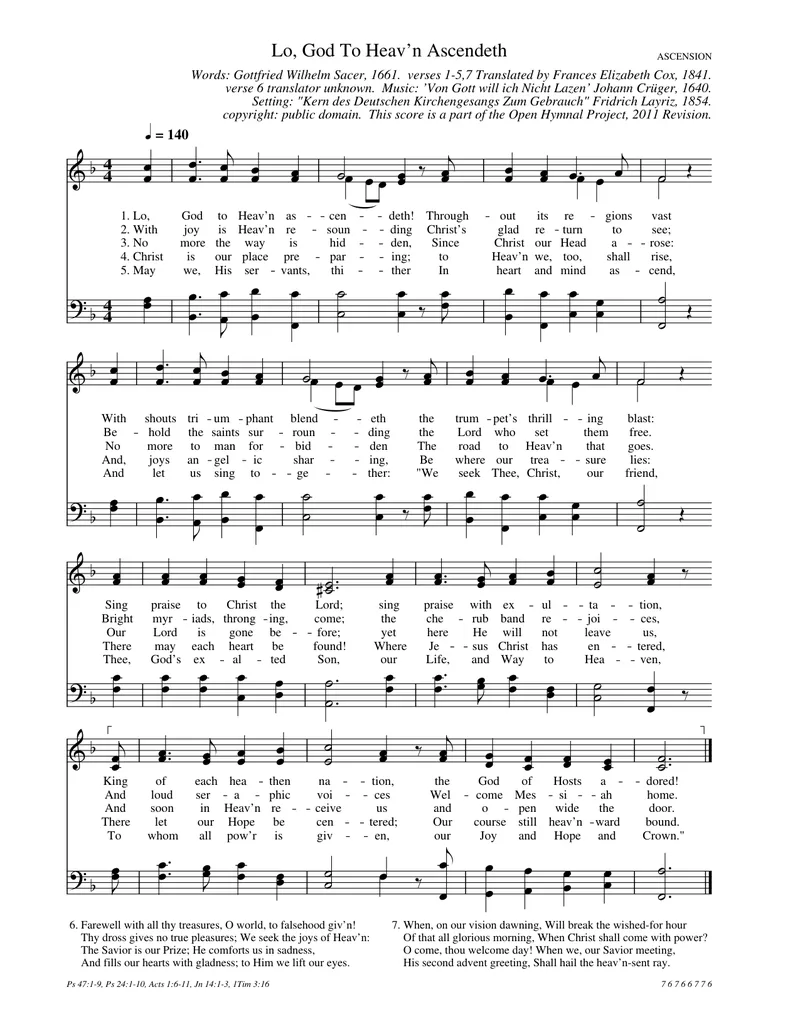
Lo, God To Heav'n Ascendeth
Interactive Recital & Tutorial Studio
Practice along with curated masterclass performances
Musicological Analysis & Practice Blueprint
Conservatory study covering harmonic architecture, articulation, and practice touch
Analytical Dossier: Tonal Grammar
Cast in F Major (one flat (B♭)), the composition organizes its melodic arcs around F. Dynamic tension arises from modulatory motion toward the relative mode of D Minor, balanced by harmonic stabilization from B-flat Major. The chordal vocabulary centers upon stable tonic statements alternating with C Major pivots. For the performer, this layout is characterized by a warm, resonant setting where navigating the single flat requires thoughtful thumb management.
Analytical Dossier: Work Attribution
From "Kern des Deutschen Kirchengesangs Zum Gebrauch" Fridrich Layriz, 1854's catalog, Lo, God To Heav'n Ascendeth remains an essential contribution to the hymnological choral and organ repertory. Comprising 48 bars across a 2-page layout, the musical text stems from traditional congregational score archives. International bibliographic tracking links the piece to reference `mbid-863a442c-sheetpdf` and ISWC `T-863.A44.2C-1`. Contextual research indicates: This Ascension hymn combines a 1661 text by Gottfried Wilhelm Sacer with Johann Crüger's seventeenth-century chorale tune. The 1854 setting by Fridrich Layriz helped preserve tradi.
Analytical Dossier: Metric Subdivision
Cast in 4/4 (simple quadruple meter), the score delivers an authoritative quadruple framework where downbeat accents anchor the overarching phrase architecture. At ♩ = 104 BPM (*Tempo di marcia*), the musical progression remains spirited with crisp finger articulation. Pedagogical directive: subdivide internally with relaxed forearm weight to prevent metric stiffness across bar lines.
Analytical Dossier: Performance Mechanics
Targeted at Easy players (early-grades syllabus (ABRSM Grade 2 standard)), this score presents rewarding interpretive and tactile hurdles. Attention should center on balancing quiet accompaniment figures beneath a clearly audible melodic statement. Accompaniment passages containing traditional choral block voicings with cantus firmus projection require subdued dynamics to spotlight the melody. Mechanically, apply smooth overlapping pedal transitions that support vocal cantabile phrasing. Practice Focus: count subdivisions out loud during practice to stabilize tempo and prevent rushing. Score pointer: Shape the opening fanfare-like phrases with a confident cantabile melody while keeping inner voices balanced. Use light pedal changes at each harmonic shift and.
Analytical Dossier: Context & Key Transposition
When programming this selection, music educators frequently schedule Lo, God To Heav'n Ascendeth for sanctuary services, choral preludes, and devotional ceremonies. Beyond the primary engraving in F Major, collaborative accompanists can adapt the key: lower voices (alto/bass) benefit from transposing into E-flat Major, while high voices gain projection in G Major. Ensembles may utilize C Major for brass fingerings. From an attribution perspective: Historical copyright on this musical work has expired globally, permitting unrestricted educational and concert use.
Frequently Asked Questions
💖 Where can I find Lo, God To Heav'n Ascendeth sheet music and chords?
You can study and view the complete 2-page printable A4 vector score of Lo, God To Heav'n Ascendeth directly in the open archive on SheetPDF. High-resolution folio viewer, interactive chords, and MIDI audio reference are also provided.
⚖️ Is Lo, God To Heav'n Ascendeth in the public domain?
Historical compositions and traditional sacred hymns by master composers are documented in the worldwide public domain, free of known copyright restrictions under US Copyright Law.
🎼 What key and tempo is Lo, God To Heav'n Ascendeth composed in?
Lo, God To Heav'n Ascendeth is arranged across standard keys, and you can easily pitch-shift it using the live in-browser chord transposition tool above.
⭐ What is the piano difficulty level?
This arrangement is rated at an Easy level, suitable for developing and experienced pianists.
🖨️ Is this formatted for standard printers?
Yes! All vector scores print cleanly on standard US Letter (8.5 × 11 in) and international ISO A4 paper without clipping.
Featured Anthologies
A Mighty Fortress: Classic Reformation & Lutheran Piano Hymns
120 ScoresJohann Pachelbel Sacred Choral Transcriptions Piano Collection (Printable PDF)
200 ScoresLudwig van Beethoven Preludes & Impromptus Piano Collection (Printable PDF)
200 ScoresLudwig van Beethoven Sacred Choral Transcriptions Piano Collection (Printable PDF)
200 ScoresChristian hymn Quick Picks
View All →Recommended Christian hymn Scores
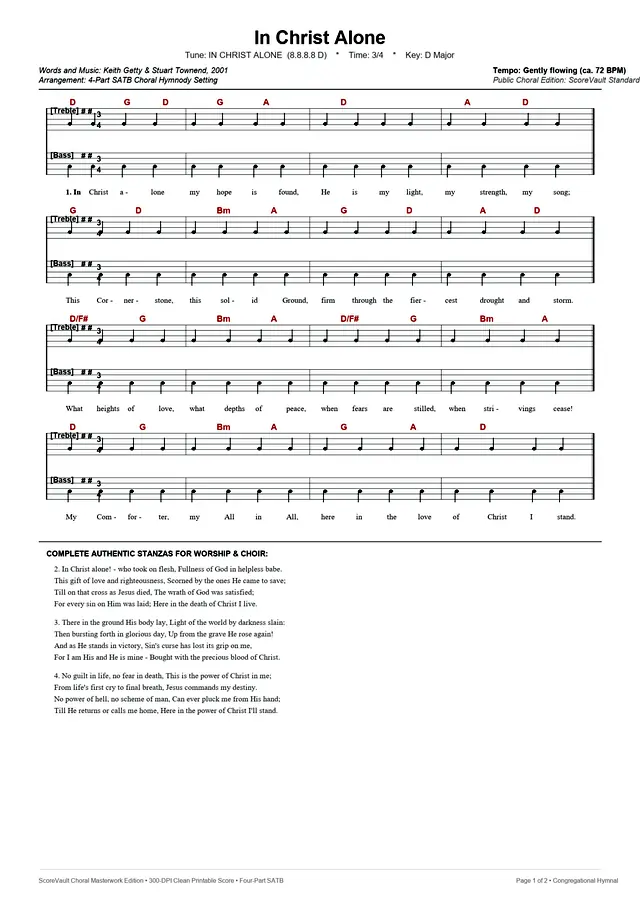
In Christ Alone
Keith Getty & Stuart Townend

How Great Thou Art
Carl Boberg (trans. Stuart K. Hine)

Blessed Assurance, Jesus Is Mine
Fanny J. Crosby

A Mighty Fortress Is Our God
"Common Service Book" (ULCA), 1917, alt
SheetPDF functions as an academic score indexing repository and digital music folio reader. Historical compositions by master composers and traditional church hymns are documented as part of the worldwide musical public domain (free of known copyright restrictions under US Copyright Law and the Berne Convention).
All transcriptions, harmonic chord charts, and editorial analyses are made available strictly for personal practice, musicological study, and scholarship in accordance with 17 U.S.C. § 107 (Fair Use) and EU Directive 2019/790. SheetPDF does not sell or distribute commercial recorded music.
If you represent a verified copyright holder and have concerns regarding an indexed arrangement, please contact our designated DMCA agent at dmca@sheetpdf.com for immediate review and accommodation.