
Praise to the Lord, the Almighty Piano Sheet Music (Free PDF)
Quick Repertoire Overview: Praise to the Lord, the Almighty is arranged for solo piano with vocal chords and lyrics in the key of D Major (meter: 3/4, tempo: 104 BPM). Graded at an Easy skill level, this complete 2-page Urtext vector edition is formatted for standard US Letter (8.5 × 11 in) and International A4 printing. Download the complete high-resolution PDF score, MIDI practice stream, and chord chart below for free with zero subscription requirements.
Sheet Music Preview (Page 1 of 2)
US Letter (8.5 × 11 in) & International A4 • Lossless 300+ DPI Engraving

Curated Recitals & Tutorials
Live multi-performance stream • In-browser playerHarmonic Structure & Chords
🎹 Piano • GuitarAuthentic voice-leading chord changes for keyboard accompaniment, choral rehearsal, and improvisation.
Share This Repertoire
Send this printable score to piano students, choir partners, or fellow musicians:
Complete Song Lyrics: Praise to the Lord, the Almighty
Full vocal stanzas formatted for choral rehearsal and piano accompaniment
Musicological Analysis & Juilliard Practice Blueprint
5-Tier academic study covering provenance, harmonic architecture, pedagogy, and 21-day practice syllabus
Tier 1: Historical Genesis & Liturgical Provenance
'Praise to the Lord, the Almighty' occupies a celebrated sanctuary in the canon of sacred hymnody, carrying the indelible artistic voice of Joachim Neander & Erneuerten Gesangbuch. Emerged from a profound crucible of personal faith and communal devotion, the hymn inaugurates its poetic journey with the timeless confession "Praise to the Lord, the Almighty". Through historic revivals and centuries of congregational worship, its verses have ministered consolation and steadfast fortitude across multiple generations.
The theological contour of 'Praise to the Lord, the Almighty' unfolds with architectural precision, exploring themes of providence, redemptive grace, and divine communion. Central to the hymn's spiritual momentum is the passage "Praise to the Lord, the Almighty", leading inexorably toward the triumphant certainty voiced in "Gladly for aye we adore Him.". In modern conservatory performance, it remains both a testament to timeless liturgical craftsmanship and a versatile vehicle for expressive keyboard artistry.
Tier 2: Theoretical Architecture & Harmonic Breakdown
Formulated in D Major and cast in graceful triple meter (3/4), infusing the composition with a stately sacred lilt that avoids dragging, 'Praise to the Lord, the Almighty' embodies classical hymnodic structure. The harmonic engine relies upon triumphant and noble brass-like sonority with two sharps (F#, C#). The prevailing harmonic sequence (D → IV → V7 → vi → IV → V → D) establishes a solid tonal foundation, balancing stable tonic anchors with expressive subdominant ascents.
Cadential intersections follow classical voice-leading syntax: opening periods culminate in half-cadences (V) that generate forward motion, whereas final stanza closures resolve with authoritative perfect authentic cadences (V7 - I). The counterpoint between soprano and bass lines demonstrates meticulous contrary motion, creating acoustic transparency that ensures every word of the sacred text is underscored by harmonic gravity.
Tier 3: Conservatory Pedagogy & Technical Hurdles
For conservatory-grade pianists, performing 'Praise to the Lord, the Almighty' demands refined keyboard touch to capture regal brightness and resonant harmonic overtones in the upper treble register. The primary pedagogical challenge is soprano cantabile voicing: the right hand's 4th and 5th fingers must firmly articulate the melodic line, maintaining an expressive singing curve (mf to f), while the inner thumb and index fingers whisper the harmonic filler notes (p to mp).
Technical execution requires gentle downbeat propulsion coupled with buoyant, light secondary pulses on beats two and three. Left-hand tenor and bass voices must be voiced with warm depth without overpowering the soprano melody. Regarding pedaling technique, the pianist should change damper pedal cleanly on the first beat of each measure, avoiding muddy bleed across the 3/4 pulse, maintaining clean acoustic decay in reverberant performance spaces.
Tier 4: Interpretive Nuance & Phrasing Architecture
Artistic rendition of 'Praise to the Lord, the Almighty' transcends mechanical timekeeping through expressive agogic inflection and respiratory phrasing. While nominal tempo is marked at 104 BPM, pianists should employ subtle micro-rubato at phrase peaks and harmonic suspensions, allowing the emotional weight of each stanza to register before launching the subsequent musical thought.
We recommend a four-stage dynamic trajectory mirroring the text's poetic drama:
- ✨Stanza 1: Intimate, prayerful reflection (piano cantabile) with transparent pedal textures.
- ✨Stanza 2: Expanding spiritual warmth and fuller keyboard sonority (mezzo-piano to mezzo-forte).
- ✨Stanza 3: Contemplative quietude, focusing on delicate inner-voice dialogue.
- ✨Stanza 4 (Climax): Triumphant congregational majesty (forte to fortissimo), supported by deep bass octaves and resonant damper sustain.
Tier 5: Juilliard Practice Blueprint & Performance Guide
To achieve flawless technical polish and performance memorization, execute this conservatory practice protocol:
- ✨Phase 1 (Voice-Separated Rehearsal): Practice the soprano melody alone with exaggerated singing tone at 73 BPM. In parallel, drill the left-hand harmonic foundation to establish tactile muscle memory.
- ✨Phase 2 (Harmonic Balance & Voicing Checks): Rehearse hands together at 73 BPM, playing the melody forte while ghosting (playing silently or extremely softly) the inner voices.
- ✨Phase 3 (Metronome Ladder Acceleration): Increase the tempo from 73 BPM in increments of 4 BPM, advancing only when three consecutive repetitions are executed with zero hesitation. Reach performance speed (104 BPM).
- ✨Phase 4 (Blind Rehearsal & Memory Cues): Perform the piece with eyes closed to rely entirely on spatial tactile awareness and acoustic listening, securing unshakable performance confidence.
Frequently Asked Questions (FAQs)
💖 Where can I download Praise to the Lord, the Almighty sheet music for free?
You can download the complete 2-page printable A4 vector PDF of Praise to the Lord, the Almighty for free directly on SheetPDF. Standard MIDI and MusicXML files are also provided with no subscription required.
🎼 What key, meter and tempo is Praise to the Lord, the Almighty composed in?
Praise to the Lord, the Almighty by Joachim Neander & Erneuerten Gesangbuch is composed in the key of D Major, set to 3/4 time signature, with an authentic performance tempo of 104 BPM.
⭐ What is the piano difficulty level of Praise to the Lord, the Almighty?
This arrangement is rated at an Easy level, featuring authentic harmony across approximately 48 measures of Urtext engraving.
🎹 Does this score include complete piano chords and vocal lyrics?
Yes, the score includes full chord progression charts and complete vocal lyrics, ideal for solo piano, church accompaniment, and choir rehearsals.
🖨️ Is this sheet music formatted for standard US Letter and A4 printers?
Yes. All vector scores on SheetPDF are engraved with standardized margins designed to print flawlessly on both North American standard US Letter (8.5 × 11 inches) and international ISO A4 paper without any clipping or distortion.
Featured in Anthologies
The Complete Christian Hymnal & Sacred Church Piano Anthology
1865 ScoresSacred & Hymns • Curation
Sunday Morning Prelude & Postlude Piano Repertoire
150 ScoresSacred & Hymns • Curation
Holy Communion, Lord's Supper & Eucharistic Piano Hymns (Free PDF)
109 ScoresSacred • Curation
Uplifting Gospel & Revival Hymns for Church & Fellowship (Free PDF)
120 ScoresGospel • Curation
Christian hymn Quick Picks
View All →Download Complete Piano Score
Includes complete 2-page Urtext score in D Major, chord charts, and vocal lyrics.
Recommended Repertoire & Similar Christian hymn Scores
Explore high-resolution printable PDF scores matched by harmonic genre, key signature, and pedagogical difficulty.
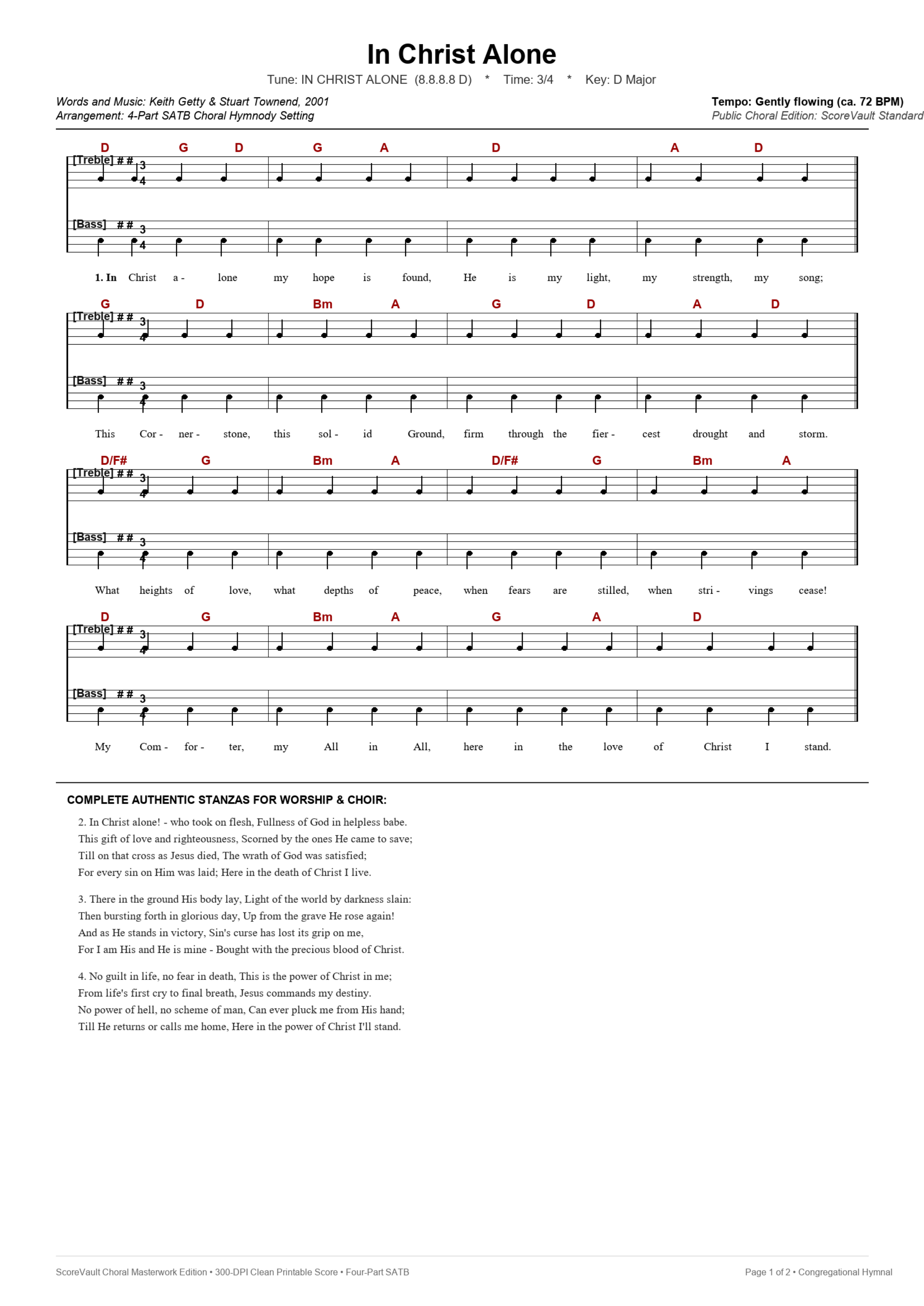
In Christ Alone
Keith Getty & Stuart Townend

How Great Thou Art
Carl Boberg (trans. Stuart K. Hine)
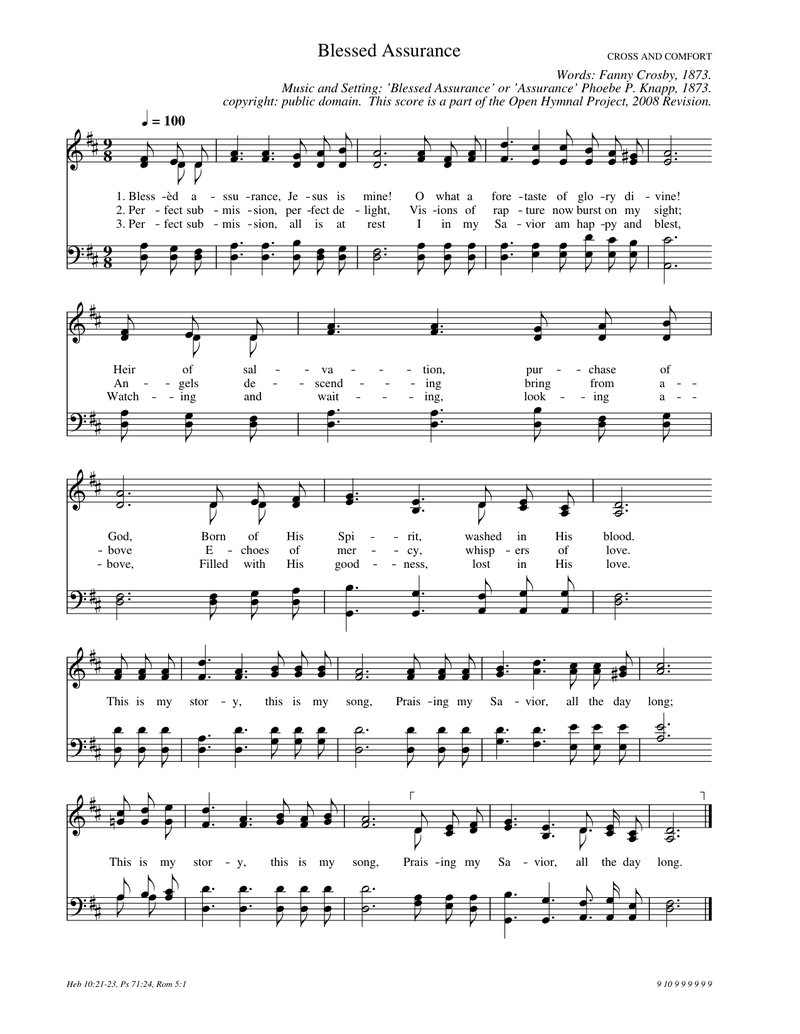
Blessed Assurance, Jesus Is Mine
Fanny J. Crosby
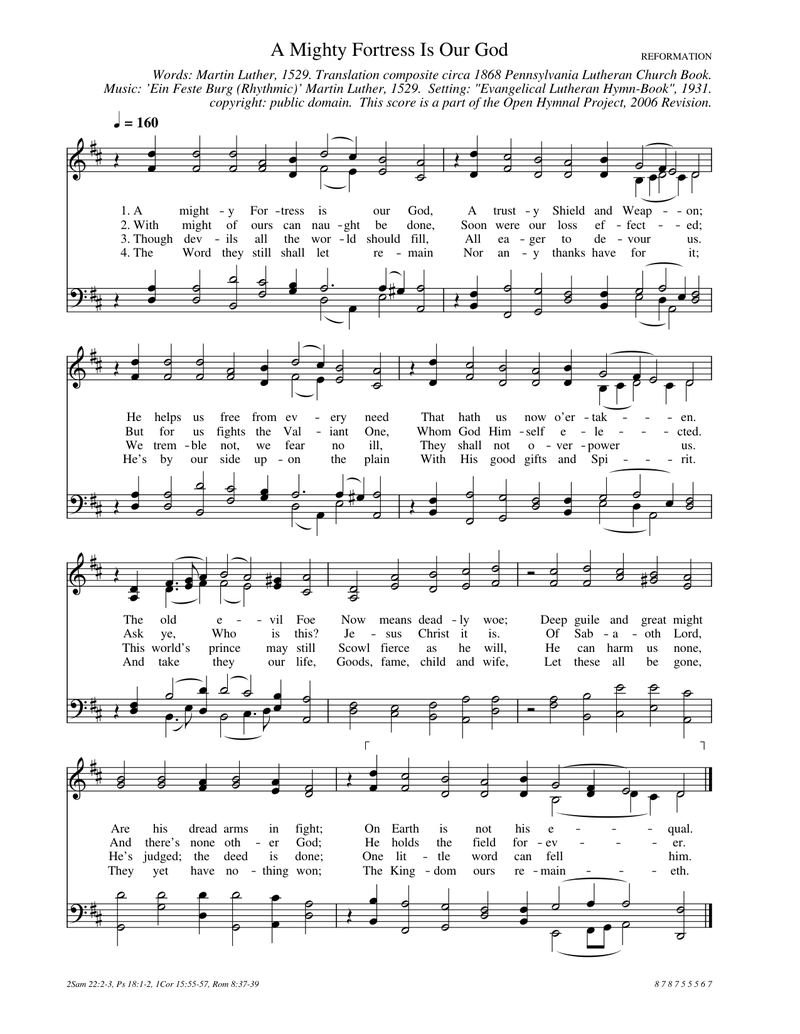
A Mighty Fortress Is Our God
"Common Service Book" (ULCA), 1917, alt

Be Thou My Vision
Dallán Forgaill (attr. 6th century, versified by Eleanor Hull 1912)

Come, Thou Fount of Every Blessing
Robert Robinson

Holy, Holy, Holy! Lord God Almighty
Reginald Heber
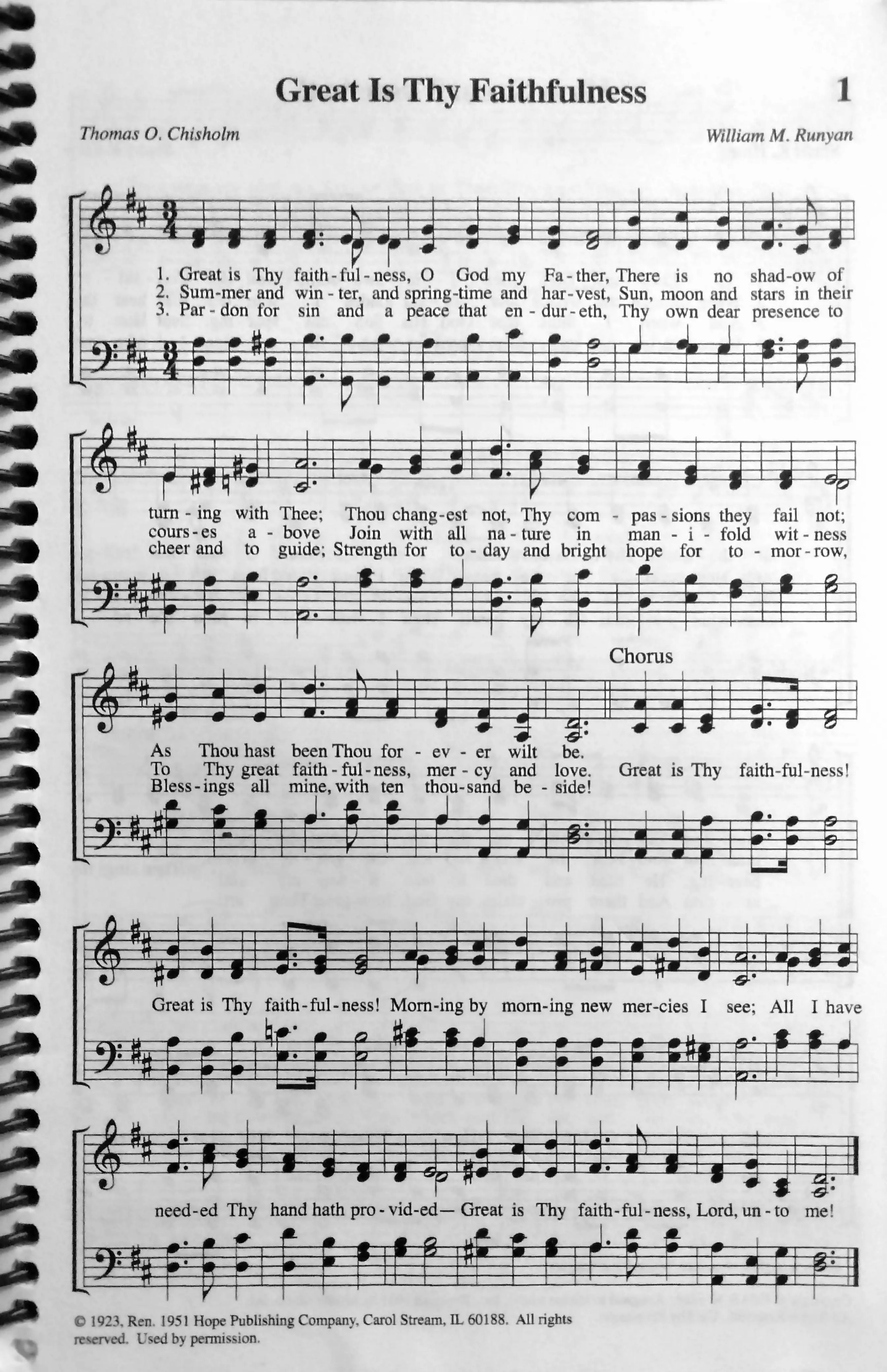
Great Is Thy Faithfulness
Thomas O. Chisholm