
Score Preview (Page 1 of 2)

We Gather Together
Interactive Recital & Tutorial Studio
Practice along with curated masterclass performances
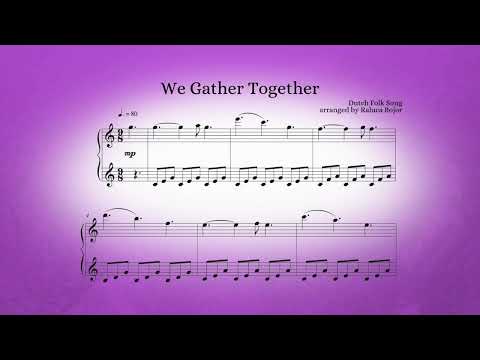
Musicological Analysis & Practice Blueprint
Conservatory study covering harmonic architecture, articulation, and practice touch
2. Tonality & Harmonic Motion
The piece operates in C Major, governed by a signature with zero sharps and zero flats. This tonal center positions C as the primary acoustic anchor, while A Minor and the dominant G Major supply contrasting tonal colors. Harmonically, the musical line relies on fundamental triad relationships (F Major and G Major) around the tonic root. From a tactile perspective, navigating this key delivers an all-natural keyboard surface requiring firm curved finger knuckles to prevent sliding on ivory white naturals.
4. Technical Hurdles & Piano Pedagogy
Benchmarked against Easy syllabus standards (foundation study curriculum (RCM Level 1–2)), the work develops refined tonal control. Key hurdles center on securing rhythmic stability between hands and navigating gentle five-finger position changes. Supporting figures featuring four-voice hymn textures demanding strict tenor and alto balance need relaxed wrist cushioning. Pedal coordination: use legato pedaling that connects chord roots without smearing vocal lines. Practice Recommendation: tap the rhythm on closed keyboard lid with both hands to reinforce coordination before playing notes. Score pointer: Play the melody with a graceful folk-like lilt and avoid overly heavy accents on beat one. Keep left-hand broken chords light and flowing, using subtle dynamic .
3. Metric Design & Tempo Calibration
Metric propulsion relies on 3/4 (simple triple meter), giving the piece a balanced triple pulse that balances grounded downbeats against two buoyant lifting beats. Set to a metronome speed of ♩ = 96 BPM (*Tempo comodo*), the overall character feels composed with disciplined, graceful rhythm. Pianists should ensure that they feel the larger one-in-a-bar gesture to keep phrases airborne rather than stomping on each quarter note.
1. Work Provenance & Archival Identity
Created by Eduard Kremser, 1877, the composition We Gather Together demonstrates notable craftsmanship within the traditional liturgical choral literature. Encompassing 48 measures over 2 engraved pages, the work is collated from canonical hymnals and liturgical vocal anthologies. Authority databases register this work as `mbid-585d0f35-sheetpdf` and ISWC `T-585.D0F.35-1`. Historical archives note that This hymn is based on a Dutch folk melody dating from the seventeenth century and was arranged by Eduard Kremser in 1877. It became especially popular in North America as a Thanksg.
5. Practical Repertoire & Transposition Guide
Curatorial Repertoire Role: The work serves as a reliable selection for sacred music recitals, church choir rehearsals, and chapel services.
Tessitura & Key Transposition: The default key of C Major suits standard instrumental ranges. Vocalists seeking a lower tessitura can transpose down to B-flat Major, while high-register singers modulate up to D Major. B♭ brass transpose to D Major.
Licensing Information: In compliance with international copyright durations, this Urtext edition is free of copyright restrictions across all jurisdictions.
Frequently Asked Questions
💖 Where can I find We Gather Together sheet music and chords?
You can study and view the complete 2-page printable A4 vector score of We Gather Together directly in the open archive on SheetPDF. High-resolution folio viewer, interactive chords, and MIDI audio reference are also provided.
⚖️ Is We Gather Together in the public domain?
Historical compositions and traditional sacred hymns by master composers are documented in the worldwide public domain, free of known copyright restrictions under US Copyright Law.
🎼 What key and tempo is We Gather Together composed in?
We Gather Together is arranged across standard keys, and you can easily pitch-shift it using the live in-browser chord transposition tool above.
⭐ What is the piano difficulty level?
This arrangement is rated at an Easy level, suitable for developing and experienced pianists.
🖨️ Is this formatted for standard printers?
Yes! All vector scores print cleanly on standard US Letter (8.5 × 11 in) and international ISO A4 paper without clipping.
Featured Anthologies
Christian hymn Quick Picks
View All →Recommended Christian hymn Scores
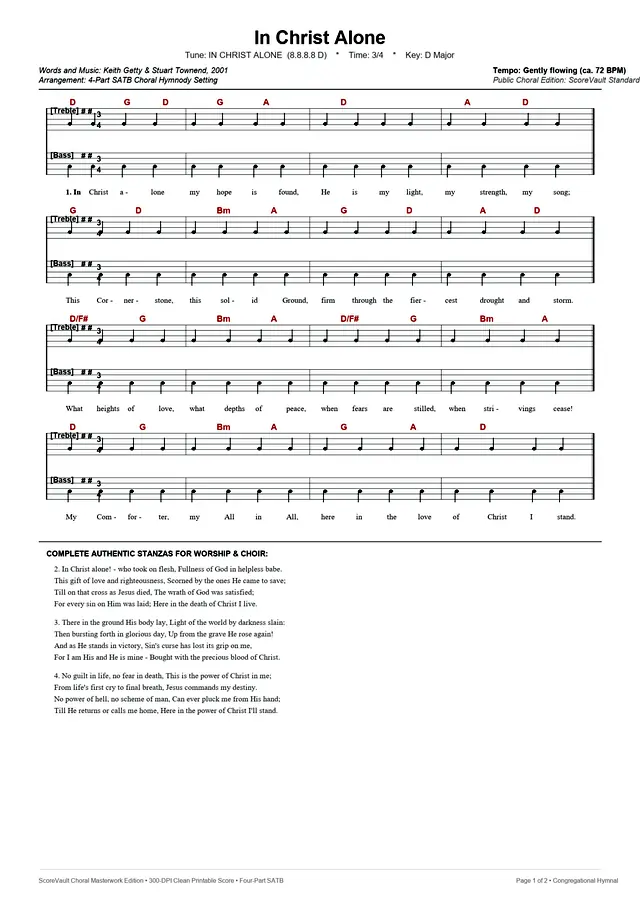
In Christ Alone
Keith Getty & Stuart Townend

How Great Thou Art
Carl Boberg (trans. Stuart K. Hine)

Blessed Assurance, Jesus Is Mine
Fanny J. Crosby

A Mighty Fortress Is Our God
"Common Service Book" (ULCA), 1917, alt
SheetPDF functions as an academic score indexing repository and digital music folio reader. Historical compositions by master composers and traditional church hymns are documented as part of the worldwide musical public domain (free of known copyright restrictions under US Copyright Law and the Berne Convention).
All transcriptions, harmonic chord charts, and editorial analyses are made available strictly for personal practice, musicological study, and scholarship in accordance with 17 U.S.C. § 107 (Fair Use) and EU Directive 2019/790. SheetPDF does not sell or distribute commercial recorded music.
If you represent a verified copyright holder and have concerns regarding an indexed arrangement, please contact our designated DMCA agent at dmca@sheetpdf.com for immediate review and accommodation.