• No videos yet!
      Click on "Watch later" to put videos here
    • View all videos  

    • Don't miss new videos
      Sign in to see updates from your favourite channels


  • Bible verses
  • Hymns
  • Today’s prayer
  • Classical Music 🎻
    • Chopin
    • Franz Liszt
  • Piano Cover
  • Romantic
  • Disney Songs
  • Wedding Songs
Sheet PDF Sheet PDF Sheet PDF

More results...

Generic selectors
Exact matches only
Search in title
Search in content
Post Type Selectors
Filter by Categories
Adele
Alan Walker
Beethoven
Bible verses
Chopin
Christmas
Classical Music 🎻
Disney Songs
Franz Liszt
Hymns
hymns & worship
J.S. Bach
Joe Hisaishi
Maroon 5
Morning prayers
Mozart
Music Notes
Music Theory
News
Piano Cover
Richard Clayderman
Romantic
Taylor Swift
Today's prayer
Uncategorized
Wedding Songs
Westlife
Yiruma
Home Hymns The Lily of the Valley

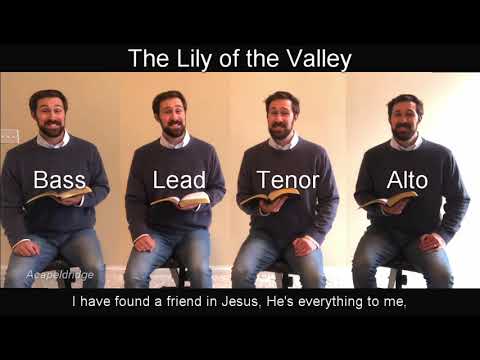
The Lily of the Valley

▶️ Don't miss this Song of the Day ◀️

  • Are You Washed in the Blood?
  • When The Roll Is Called Yo Yonder
  • The Church’s One Foundation
  • Lift High the Cross
  • 103 Year-Old Woman Still Singing Gospel Hymns

 
There are hymns that we sing because they are familiar. There are hymns that we sing because they belong to a particular season of the church year. And then there are hymns that seem to find us when we are carrying something heavy.
The Lily of the Valley is one of those hymns.
Many people know it by its opening line: “I have found a friend in Jesus.” That simple sentence carries the heart of the entire song. The hymn is not written from the distance of abstract theology. It is written as a testimony. Someone has suffered, searched, struggled and discovered that Christ is not merely an idea to be believed, but a presence to be trusted.
The song speaks of sorrow, temptation, loneliness and fear. Yet it does not remain in darkness. Again and again, it returns to the same confession: Jesus is the believer’s comfort, shelter, companion and hope.
That is why this hymn continues to speak to people across generations. Its language is old, but the experience behind it is not. People still feel alone. They still carry grief that cannot be explained easily. They still wonder whether they will have the strength to continue. In the middle of those realities, The Lily of the Valley offers a quiet answer: Christ is near, and His faithfulness is greater than our weakness.

A hymn born from faith and service

The words of The Lily of the Valley were written in 1881 by Charles William Fry, a British Methodist lay preacher, musician and Christian worker. Fry was closely connected with the early Salvation Army, a movement that placed great importance on public preaching, congregational singing and music in the streets.
Fry’s life was not separated from music. He and members of his family helped support Salvation Army meetings with brass instruments. In that setting, music was not treated as decoration. It was a way of gathering people, carrying the message of the gospel into public places and giving ordinary worshipers words they could remember and sing for themselves.
The hymn first appeared in the early 1880s and was later included in Salvation Army music collections. Historical research published by United Methodist Discipleship Ministries records that the hymn has appeared in more than 370 hymnals and has continued to cross denominational, cultural and national boundaries .
That wide circulation tells us something important. The hymn did not survive simply because it was old. It survived because people continued to recognize their own lives in it. A person who had never met Charles Fry could still sing his words and say, “Yes, this is what I need to remember today.”
The Lily of the Valley - Wikipedia

The voice of someone who has found a friend

The hymn begins with a personal discovery:
“I have found a friend in Jesus; He’s everything to me.”
The words are direct, almost conversational. They do not begin by trying to prove anything. They begin with the testimony of someone who has found what he or she was looking for.
The word friend gives the hymn its warmth. A friend is not distant. A friend is someone we can approach with honesty. A friend remains present when our public strength disappears. When the hymn calls Jesus a friend, it is speaking about more than affection. It is speaking about trust, companionship and the assurance that we are not abandoned in the places where life becomes difficult.
This is especially meaningful because the hymn does not describe a life without pain. The singer speaks about sorrow and trouble from the very beginning. The promise is not that faith will prevent every hardship. The promise is that hardship does not have the final word, and that suffering does not have to be carried alone.
There are moments when people cannot find a long prayer. They may not know what to say. A familiar hymn can become that prayer for them. The words give shape to feelings that are difficult to express: “I am tired, but I am not alone. I am afraid, but I know where to turn. I am weak, but I do not have to depend on my own strength.”
For that reason, The Lily of the Valley belongs not only in a church service. It also belongs in the quiet room, beside a hospital bed, during a difficult journey, or in the early morning when the heart is searching for courage.

Why the title matters

The title is drawn from the rich poetic language of the Bible. The image of the lily appears in the Song of Solomon, where it belongs to a poem filled with images of beauty, love and longing. Christian tradition has often applied some of this language devotionally to Christ, and the hymn follows that tradition.
The title does not present Jesus as a remote king who cannot be approached. It presents Him as something beautiful and precious to the soul. The image of a flower growing in a valley is also gentle. A valley is not always a place of ease. It can be low, hidden and surrounded by difficult terrain. Yet even there, something living and beautiful can grow.
That image speaks to many Christian experiences. Faith is not lived only on mountaintops. Much of life is spent in valleys: seasons of waiting, disappointment, illness, grief, uncertainty or change. The hymn suggests that Christ is not absent from those places. He is present there as well.
The refrain adds another image: “the Bright and Morning Star.” This title is connected with Revelation 22:16, where Jesus identifies Himself as the bright morning star. A morning star appears while the night is still present, but it announces that a new day is approaching.
That is a beautiful way to understand Christian hope. Hope does not always mean that every problem has already disappeared. Sometimes hope begins as a small light while the darkness is still around us. The hymn teaches the singer to look toward that light and to trust that night will not last forever.

Comfort in sorrow and trouble

The first verse moves quickly from the beauty of Christ to the reality of human pain:
“In sorrow He’s my comfort, in trouble He’s my stay.”
These words are memorable because they are honest. They do not treat sorrow as a sign that faith has failed. They assume that sorrow is part of human life and ask where comfort can be found when it arrives.
To call Christ a “stay” is to describe Him as support. A person who is exhausted may not need a dramatic speech. They may need something that keeps them from falling. In the language of the hymn, Jesus is that support. He is the one who enables the believer to remain standing when circumstances have taken away confidence and strength.
The next line gives this comfort a practical direction:
“He tells me every care on Him to roll.”
The image echoes Psalm 55:22, which invites God’s people to cast their burdens upon Him. It does not suggest that our responsibilities are unimportant. It suggests that we were never meant to carry every burden as though we were God ourselves.
There is a kind of tiredness that comes from carrying the future, other people’s decisions, our own mistakes and fears about what may happen next. The hymn invites us to release that burden, not because life is simple, but because God is able to sustain us within its complexity.
This is one reason the hymn remains valuable in pastoral settings. It does not offer shallow optimism. It gives people permission to acknowledge pain while also reminding them that pain can be brought into the presence of Christ.

Strength when faith is tested

The second verse speaks about temptation and describes Jesus as a “strong and mighty tower.” In the ancient world, a tower was a place of protection and watchfulness. It offered refuge when danger approached.
The image is deeply relevant to spiritual life. Temptation is not always loud or obvious. Sometimes it appears as discouragement, resentment, pride, despair or the belief that we must save ourselves. Sometimes it is the slow loss of trust that comes after repeated disappointment.
The hymn does not tell the believer to pretend to be invulnerable. It points instead to a strength outside the self. The singer admits that the world may forsake him and that Satan may tempt him sorely, yet still declares that through Jesus he will reach the goal.
This is not a celebration of human willpower. It is a confession of dependence. The believer continues not because he or she has never been weak, but because Christ’s power is greater than weakness.
For those who appreciate hymns that speak honestly about spiritual struggle, this theme connects naturally with He Leadeth Me
, another hymn centered on the trust that God leads His people through changing circumstances. It also resonates with Be Thou My Vision, which expresses the desire for Christ to become the believer’s wisdom, focus and deepest treasure.

The promise that God will not leave us

The final verse contains perhaps the most tender promise in the hymn:
“He will never, never leave me, nor yet forsake me here.”
The repetition of “never” gives the line the quality of a hand placed firmly on someone’s shoulder. It is not hurried. It is meant to be remembered.
Human life is full of change. Friendships change. Families move through seasons. Health changes. Work changes. The places that once felt secure may no longer be familiar. Even our own emotions can change quickly. We may feel close to God one day and distant the next.
The hymn points to a faithfulness that does not depend on the stability of our feelings. The singer may not understand everything that is happening, but he or she can still hold to the conviction that Christ does not abandon His people.
This does not mean that a Christian will never experience silence, doubt or sorrow. In fact, the hymn’s confidence becomes meaningful precisely because it is sung in a world where people do experience those things. Its message is not that the valley is imaginary. Its message is that the valley is not empty.
Readers who are moving through a season of waiting may also find comfort in When God Is Silent, He Is Still Working, a related reflection on trusting God when His work is not immediately visible.

The hymn’s journey across cultures

The story of The Lily of the Valley is also a story about how Christian music travels. The hymn began in the setting of nineteenth-century British and Salvation Army evangelism, but it did not remain there. It entered many Protestant hymnals and became part of the worship life of churches from different traditions.
The song’s simple testimony made it adaptable. A congregation did not need to know the details of its history in order to sing about Christ as comfort, strength and friend. The words could be carried into a new language and a new cultural setting without losing their central message.
Research on the hymn records its presence in many hymnals and notes its life in Spanish-speaking Christian communities as well . This helps explain why older hymns can remain spiritually alive long after the circumstances of their composition have passed. Their language may be translated, their melodies may be arranged differently and their worship settings may change, but the human needs they address remain familiar.
The hymn’s melody also has a complicated history. It is commonly associated with William Shakespeare Hays and an earlier secular melody that Charles Fry adapted for sacred words . That history should be acknowledged honestly. At the same time, the lasting identity of the hymn rests in the way Christian communities received the melody and joined it to a testimony of faith.

The Lily of the Valley lyrics

The traditional English text is attributed to Charles William Fry. Different hymnals may vary slightly in punctuation, spelling and wording.

Verse 1

I have found a friend in Jesus, He’s everything to me,

He’s the fairest of ten thousand to my soul;

The Lily of the Valley, in Him alone I see

All I need to cleanse and make me fully whole.

In sorrow He’s my comfort, in trouble He’s my stay;

He tells me every care on Him to roll.

Refrain

He’s the Lily of the Valley,

The Bright and Morning Star;

He’s the fairest of ten thousand to my soul.

Verse 2

He all my grief has taken, and all my sorrows borne;

In temptation He’s my strong and mighty tower;

I have all for Him forsaken, and all my idols torn

From my heart, and now He keeps me by His power.

Though all the world forsake me, and Satan tempts me sore,

Through Jesus I shall safely reach the goal.

Refrain

Verse 3

He will never, never leave me, nor yet forsake me here,

While I live by faith and do His blessed will;

A wall of fire about me, I’ve nothing now to fear;

With His manna He my hungry soul shall fill.

Then sweeping up to glory, to see His blessed face,

Where rivers of delight shall ever roll.

Refrain

A hymn for worship, prayer and ordinary life

There are many settings in which this hymn can be sung. It can become a song of assurance during a worship service, a testimony of gratitude at a family gathering, or a personal prayer during a difficult week.
It is especially fitting when a congregation is reflecting on comfort, perseverance, salvation, friendship with Christ or the faithfulness of God. The repeated refrain allows everyone to participate, even when a person may not remember every verse.
The hymn can also be meaningful for someone who is returning to faith after a long absence. Its language is not complicated. It does not demand that the singer have every question answered before coming to Christ. It begins with a relationship: “I have found a friend.”
That simplicity should not be mistaken for shallowness. The song contains a mature understanding of faith. It knows that sorrow exists. It knows temptation is real. It knows the world can disappoint us. Yet it also knows that a life held by Christ can continue to grow in the valley.
Those who are drawn to hymns of future hope may wish to read I’ll Fly Away, while those who want to explore the wider collection can visit SheetPDF’s Hymns.

A final reflection

The Lily of the Valley remains powerful because it does not ask us to choose between honesty and hope. It allows us to speak about grief without giving up on God. It allows us to admit weakness without believing that weakness is the end of the story.
The hymn reminds us that Christ can be known in more than one way. He is the Savior, but also the friend. He is the Bright and Morning Star, but also the one who meets us in the valley. He is the source of eternal hope, but also the comfort we need today.
Perhaps the most important message of the song is found in its first sentence. To say, “I have found a friend in Jesus,” is to say that faith is not only about reaching a destination. It is also about discovering companionship along the way.
When the heart is burdened, the hymn teaches us to bring that burden to Christ. When courage fails, it teaches us to seek strength beyond ourselves. When the future is uncertain, it teaches us to look toward the light that appears before dawn.
And when the road passes through a valley, it reminds us that we are not walking alone.


✦✦✦ Related Articles ✦✦✦

  • Are You Washed in the Blood?
  • When The Roll Is Called Yo Yonder
  • The Church’s One Foundation
  • Lift High the Cross
  • 103 Year-Old Woman Still Singing Gospel Hymns

Tags Bible versesChristian hymnChristian hymnsChristian livingClassical Music 🎻holyspiritHymnsHymns of Faithold hymnsPiano CoverSpiritual GrowthSpiritualGrowthThe Lily of the Valley

RELATED POSTS

I Know That My Redeemer Lives
Watch LaterAdded 06:15

I Know That My Redeemer Lives

The Battle Hymn of the Republic
Watch LaterAdded 03:17

The Battle Hymn of the Republic

Come, Behold the Wondrous Mystery
Watch LaterAdded 04:14

Come, Behold the Wondrous Mystery

He’s Got the Whole World in His Hands
Watch LaterAdded 02:38

He’s Got the Whole World in His Hands

Thank You, Lord
Watch LaterAdded 01:56

Thank You, Lord

Without Him
Watch LaterAdded 02:30

Without Him

I Believe in a Hill Called Mount Calvary
Watch LaterAdded 03:48

I Believe in a Hill Called Mount Calvary

Lead me to Calvary
Watch LaterAdded 04:43

Lead me to Calvary

MOST VIEWED VIDEOS

I Know That My Redeemer Lives06:15

I Know That My Redeemer Lives

admin
74.8M
4.6M
The Battle Hymn of the Republic03:17

The Battle Hymn of the Republic

admin
87.5M
6.6M
Come, Behold the Wondrous Mystery04:14

Come, Behold the Wondrous Mystery

admin
4.9M
362.8K
He’s Got the Whole World in His Hands02:38

He’s Got the Whole World in His Hands

admin
8.7M
456.7K

MOST LIKED VIDEOS

Sweet Beulah Land
Watch LaterAdded 04:34

Sweet Beulah Land

admin
20K
Trust And Obey
hymnHymns
Watch LaterAdded 04:31

Trust And Obey

admin
7M
103 Year-Old Woman Still Singing Gospel Hymns
Watch LaterAdded 01:54

103 Year-Old Woman Still Singing Gospel Hymns

admin
83.8M
When we all get to Heaven
Watch LaterAdded 02:52

When we all get to Heaven

admin
34.4K
What A Day That Will Be
hymnHymns
Watch LaterAdded 04:09

What A Day That Will Be

admin
16.6M

TUTORIAL

1
1

Joe Hisaishi

admin
May 10, 2023
Richard Claydeman (1)2

Richard Claydeman

admin
May 6, 2023
1390549236155_5003

Yiruma

admin
May 6, 2023
Classical Music 🎻 (1)4

Classical Music 🎻

admin
May 5, 2023 May 7, 2023
pianocover5

Piano Cover

admin
May 5, 2023 May 7, 2023

POPULAR

SHEET

Santa Claus is Coming to Town
Watch LaterAdded 01:04

Santa Claus is Coming to Town

admin
7.9T
33.7K
Have Yourself A Merry Little Christmas – Jazz Christmas
Watch LaterAdded 02:39

Have Yourself A Merry Little Christmas – Jazz Christmas

admin
10B
2.1B
I Surrender All
Watch LaterAdded 04:43

I Surrender All

admin
6.7B
1.2M
Grade 1 Music Theory Test
Watch LaterAdded 06:42

Grade 1 Music Theory Test

admin
124.3M
2.1B
Be Thou My Vision – The Timeless Christian Hymn of Surrender, Wisdom, and Divine Guidance
Watch LaterAdded 03:45

Be Thou My Vision

admin
2.1B
7.6M
Jingle Bell Rock – Jazz Christmas
Watch LaterAdded 02:33

Jingle Bell Rock – Jazz Christmas

admin
669.9M
669.9M
O Come, O Come, Emmanuel
Watch LaterAdded 03:46

O Come, O Come, Emmanuel

admin
1.2B
63.5M
Crown Him with Many Crowns
Watch LaterAdded 02:49

Crown Him with Many Crowns

admin
1.2B
10M


Welcome to the Pianist Forum, where piano enthusiasts can come together and discuss all things related to playing the piano. As a pianist, you know that playing the instrument can be a challenging yet rewarding experience.

That’s why we have created this forum to bring together like-minded individuals who enjoy playing the piano. Whether you’re a beginner or an experienced pianist, this forum is for you. Share tips and techniques, ask for advice, or simply chat with other members of the community. . So, join the Pianist Forum today, and let’s make beautiful music together! DMCA.


Copyright © 2023. Created by Pianist Forum.


    • No videos yet!
      Click on "Watch later" to put videos here
    • View all videos  

    • Don't miss new videos
      Sign in to see updates from your favourite channels


  • Bible verses
  • Hymns
  • Today’s prayer
  • Classical Music 🎻
    • Chopin
    • Franz Liszt
  • Piano Cover
  • Romantic
  • Disney Songs
  • Wedding Songs