
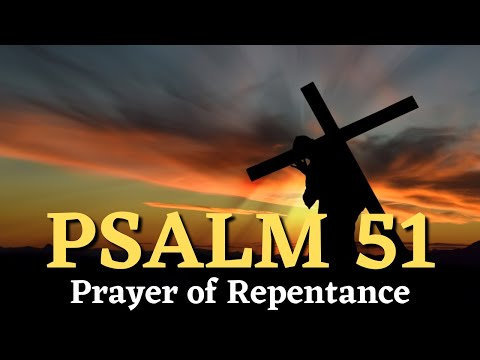
Psalm 51 — When Grace Begins Where Excuses End
▶️ Don't miss this Song of the Day ◀️
The Night a King Stood Without a Crown
“Have mercy on me, O God, according to Your steadfast love; according to Your abundant mercy blot out my transgressions.”
Psalm 51:1
Some prayers are remembered because they changed history.
Others are remembered because they changed the person who prayed them.
Psalm 51 belongs to the second kind.
For nearly three thousand years, these words have been whispered in monasteries before dawn, sung in great cathedrals during Lent, prayed quietly beside hospital beds, and spoken through tears by countless believers who could no longer carry the weight of their own failures. No other psalm has so profoundly shaped the Christian understanding of repentance, not because it explains sin with theological precision, but because it allows us to hear the sound of a heart returning to God.
It is striking that one of the Bible’s most beloved prayers was not written during Israel’s greatest victory.

It was born from one of its darkest scandals.
Behind every line of Psalm 51 stands a story that begins not with worship, but with desire; not with triumph, but with deception; not with praise, but with silence.
David, the shepherd who became king, the poet who composed songs of trust, the young man who once stood before Goliath with nothing but a sling and unwavering faith, had reached the height of earthly success. His kingdom was secure. His enemies had largely been subdued. The covenant promises spoken over his life appeared to be unfolding before the eyes of the nation.
Yet Scripture tells us that it was precisely at this moment of outward stability that something within David began to fracture.
Sin rarely enters a life by announcing itself.
More often, it arrives quietly, disguised as entitlement, comfort, or a single compromise that seems too small to matter.
The tragedy of David’s fall did not begin on a rooftop in Jerusalem.
It began long before that—when vigilance gave way to self-confidence and the heart slowly drifted from the humility that had once defined it.
The King Who Stayed Behind
The narrative recorded in 2 Samuel 11 begins with an observation that many readers overlook.
“In the spring of the year, the time when kings go out to battle… David remained at Jerusalem.”
The sentence appears almost incidental.
Yet biblical authors rarely waste details.
Throughout Israel’s history, kings were expected to lead their people in times of war. David himself had built his reputation on courage displayed in battle. He had walked into valleys where others feared to stand. Now, for the first time, the king remains behind while others fight in his place.
The danger was not rest.
The danger was distance from the calling God had entrusted to him.
There is a subtle spiritual principle hidden within this moment.
The greatest temptations often do not arise when life is difficult.
They emerge when success persuades us that we no longer need the disciplines that once kept our hearts close to God.
David walks across the roof of his palace and sees Bathsheba.
What follows unfolds with heartbreaking speed.
Desire becomes action.
Action requires deception.
Deception demands greater deception.
When Bathsheba becomes pregnant, David attempts to conceal his sin by recalling her husband, Uriah, from the battlefield. When Uriah refuses the comfort of home while his fellow soldiers remain at war, David arranges something almost unimaginable.
He sends Uriah back carrying the very letter that orders his own death.
The shepherd who once risked his life for his people now sacrifices one of his most faithful soldiers to protect his own reputation.
Sin has an extraordinary ability to distort the human heart.
It promises freedom.
It leaves slavery.
It promises secrecy.
It creates isolation.
It promises control.
It produces fear.
Perhaps this explains why Scripture never presents sin merely as the breaking of divine commandments.
It portrays sin as the gradual unraveling of the person God created us to become.
The Prophet Who Refused to Look Away
For nearly a year, David succeeded in hiding the truth from everyone around him.
The palace continued to function.
The kingdom remained stable.
Life appeared normal.
Yet the biblical narrative adds one unforgettable sentence:
“But the thing that David had done displeased the Lord.”
Human beings often measure guilt by whether anyone discovers it.
God measures it by truth.
The silence is finally broken when the prophet Nathan enters the royal court.
Nathan does not begin with accusation.
He tells a story.
There were two men, he says, one rich and one poor. The rich man possessed countless flocks and herds, while the poor man owned only one little ewe lamb—a creature so beloved that it ate from his table, drank from his cup, and rested in his arms like a daughter.
When a traveler arrived, the rich man refused to sacrifice one of his own many animals.
Instead, he took the poor man’s only lamb.
David’s anger burns immediately.
The injustice seems obvious.
“The man who has done this deserves to die.”
Then Nathan speaks four words that echo through the centuries.
“You are the man.”
Few moments in Scripture are more devastating.
David, who had judged the rich man without hesitation, suddenly realizes that he has unknowingly pronounced judgment upon himself.
This is how the Word of God often works.
Before it changes our behavior, it unmasks our illusions.
The prophet does not merely expose David’s actions.
He reveals David’s heart.
When Every Excuse Falls Silent
One of the most remarkable features of Psalm 51 is not what David says.
It is what he never says.
He does not blame power.
He does not blame loneliness.
He does not blame Bathsheba.
He does not blame cultural customs.
He does not even blame temptation.
There is no attempt to soften responsibility.
Instead, he begins with the only place where genuine repentance can begin:
“Have mercy on me, O God.”
The Hebrew word translated “mercy” is rooted in one of the richest theological concepts of the Old Testament—ḥesed.
No single English word fully captures its meaning.
It speaks of God’s steadfast covenant love, His faithful kindness, His unwavering commitment to His people even when they have failed Him.
David does not appeal to his achievements.
He cannot.
He does not remind God of Goliath.
He does not mention the Ark of the Covenant.
He does not point to years of faithful leadership.
He places his entire hope in the character of God.
This is one of the most beautiful movements in all of biblical prayer.
Repentance begins not with confidence in ourselves.
It begins with confidence in God’s mercy.
For generations, Christian theologians have observed that David’s prayer is remarkable precisely because it looks beyond justice to grace. If David had appealed to justice alone, he would have stood condemned by his own actions. Instead, he throws himself upon the covenant love of the God he has wounded.
This distinction continues to shape Christian prayer today.
Believers do not approach God because they have earned another opportunity.
They come because they trust that His mercy is greater than their failure.
More Than Forgiveness
David continues:
“Wash me thoroughly from my iniquity, and cleanse me from my sin.”
Notice the imagery.
He does not ask merely to be excused.
He asks to be cleansed.
In the world of ancient Israel, cleansing was deeply connected to worship. Before entering sacred spaces, priests underwent ritual washings that symbolized purification before the holiness of God. David draws upon that language because he understands something profoundly important.
His deepest problem is not that he has broken a rule.
His deepest problem is that sin has damaged communion with the God for whom his soul was created.
Saint Augustine would later write that the human heart remains restless until it rests in God.
Psalm 51 reveals what happens when that relationship has been fractured.
The soul does not simply feel guilty.
It feels homeless.
This is why David longs for cleansing rather than mere acquittal.
He is not seeking to escape consequences.
He longs to return to fellowship.
And perhaps that is why Psalm 51 still speaks with such extraordinary power today.
Every generation discovers that failure takes many forms.
Some failures are public.
Most are hidden.
Yet beneath every honest confession lies the same quiet longing:
Not merely to feel better.
Not merely to start over.
But to come home to the God whose mercy is deeper than our deepest shame.
The Heart That Only God Can Create
There is a noticeable change in Psalm 51.
The opening verses are filled with confession.
David speaks of transgressions, iniquity, guilt, and sin. Every sentence carries the weight of a man who has finally stopped hiding. Yet beginning in verse 10, the prayer moves beyond confession toward something even deeper.
David no longer asks only to be forgiven.
He asks to be remade.
This distinction lies at the heart of the Christian understanding of repentance.
Many people long for forgiveness because they want relief from guilt.
David longs for something far greater.
He wants to become a different man.
“Create in Me a Clean Heart”
Among all the prayers recorded in Scripture, few have echoed through Christian worship more than these words:
“Create in me a clean heart, O God, and renew a right spirit within me.”
The verse is so familiar that it is easy to overlook how astonishing it truly is.
David does not ask God to improve his heart.
He does not pray,
“Help me become a better person.”
Nor does he ask,
“Repair what I have broken.”
Instead, he uses one of the most extraordinary verbs in the Hebrew Scriptures.
The word translated “create” is בָּרָא (bara).
Throughout the Old Testament, this verb is used almost exclusively for God’s creative activity. It is the same word that opens the Bible:
“In the beginning, God created the heavens and the earth.” (Genesis 1:1)
Human beings build.
They plant.
They shape.
They restore.
But bara belongs uniquely to God.
It describes an act that only the Creator can perform.
David understands something that many people spend an entire lifetime trying to avoid.
His greatest problem is not that his behavior has become corrupt.
It is that his heart has become corrupted.
A damaged heart cannot heal itself.
A sinful heart cannot recreate itself.
Only the God who once breathed life into Adam can create new life within the human soul.
This single word quietly anticipates one of the central themes of the New Testament.
Centuries later, the prophet Ezekiel would proclaim God’s promise:
“I will give you a new heart and put a new spirit within you.”
Jesus would speak to Nicodemus about being born again, not merely becoming morally improved but receiving new life from above.
The Apostle Paul would later write,
“If anyone is in Christ, he is a new creation.”
The Bible tells one continuous story.
Creation.
Fall.
Redemption.
New Creation.
Psalm 51 stands near the center of that story.
David’s prayer reaches forward to the Gospel long before the cross is raised on Calvary.
The Presence David Feared to Lose
David continues,
“Cast me not away from Your presence, and take not Your Holy Spirit from me.”
To modern readers, these words can be unsettling.
Does this mean God abandons those who fail?
To understand David’s prayer, we must remember where he stands within the unfolding story of redemption.
David had witnessed what happened to King Saul.
The Spirit of the Lord, who had empowered Saul for his royal calling, departed from him because of persistent rebellion. David knows that leadership without God’s presence is empty. A throne without communion with God is only another form of exile.
Yet notice what David fears most.
He does not pray,
“Do not take my kingdom.”
He does not ask,
“Do not take my wealth.”
He never mentions military victories or political influence.
His deepest fear is spiritual separation.
This reveals how profoundly repentance has transformed his priorities.
Before confronting his sin, David risked everything to protect his reputation.
Now he is willing to lose everything except the presence of God.
The order of his loves has finally been restored.
Augustine famously wrote that sin is ultimately a disordering of love—we love lesser things more than the greatest Good. Psalm 51 beautifully illustrates the reverse. Grace does not simply erase guilt; it reorders the human heart until God once again becomes its highest treasure.
The Joy That Sin Cannot Produce
One verse in Psalm 51 quietly overturns many modern assumptions about happiness.
“Restore to me the joy of Your salvation.”
David does not ask God to restore pleasure.
He asks Him to restore joy.
The difference is profound.
Pleasure often depends upon circumstances.
Joy is rooted in relationship.
David had possessed unimaginable wealth.
Military success.
Honor among nations.
Royal authority.
Yet after his sin, none of these things could quiet the unrest within his soul.
This is one of Scripture’s most penetrating insights into the human condition.
Sin always promises happiness.
It never delivers lasting joy.
It may satisfy desire for a moment.
It cannot satisfy the heart that was created for communion with God.
Centuries later, Blaise Pascal would describe within every person a longing that no earthly success can fill because it was made for God Himself.
David discovered this truth long before Pascal put it into words.
He had gained everything a king could desire.
Yet without fellowship with God, he found himself spiritually impoverished.
Only grace could restore what success never could.
From Brokenness to Worship
The closing movement of Psalm 51 contains one of the Bible’s most beautiful paradoxes.
David writes,
“For You will not delight in sacrifice, or I would give it… The sacrifices of God are a broken spirit; a broken and contrite heart, O God, You will not despise.”
At first glance, these words may seem surprising.
After all, the Old Testament contains detailed instructions concerning sacrifices.
Why does David appear to minimize them?
The answer is not that sacrifices no longer matter.
It is that ritual without repentance has always been empty.
God never desired offerings separated from transformed hearts.
Throughout Israel’s history, the prophets returned repeatedly to this truth.
Isaiah declared that worship becomes meaningless when justice is abandoned.
Hosea proclaimed,
“I desire mercy, not sacrifice.”
Micah asked whether thousands of rams could please God before answering that the Lord requires justice, mercy, and humble fellowship with Him.
David now understands what every prophet would later proclaim.
God seeks the worshiper before He seeks the offering.
The altar means little if the heart remains unchanged.
This truth reaches its fulfillment in Christ.
The New Testament does not abolish worship.
It deepens it.
Through the sacrifice of Jesus, believers are invited to offer not merely external gifts but their entire lives as “living sacrifices, holy and acceptable to God.”
Repentance is therefore not the end of worship.
It is the place where true worship begins.
Why Psalm 51 Still Speaks Today
Three thousand years have passed since David first prayed these words.
Kingdoms have disappeared.
Languages have changed.
Empires have risen and fallen.
Yet Psalm 51 continues to be prayed by Christians around the world because its deepest themes have never grown old.
Every generation knows what it is to fail.
Every generation understands regret.
Every generation discovers that human beings possess an extraordinary ability to hide from one another—and an equally extraordinary inability to hide from God.
Yet the enduring power of Psalm 51 is not found in its description of sin.
It is found in its confidence in grace.
David approaches God with empty hands.
He cannot erase the past.
He cannot undo Uriah’s death.
He cannot reclaim his innocence.
But he believes something even greater.
The God who created the heavens and the earth is still able to create a clean heart within a broken sinner.
That hope reaches its fullest expression in Jesus Christ.
The One whom David called “my Shepherd” became the Good Shepherd who laid down His life for His sheep.
The God whose mercy David pleaded for revealed that mercy completely at the cross, where justice and grace met without contradiction.
Psalm 51 therefore remains far more than an ancient royal prayer.
It is the prayer of every believer who has discovered that the deepest miracle of God’s grace is not merely that He forgives the guilty.
It is that He transforms them.
Perhaps that is why these words continue to echo across centuries of Christian worship.
We spend much of our lives trying to repair the image we present to the world.
God is patiently creating something far more beautiful.
Not a better reputation.
Not a more impressive appearance.
But a new heart.
And wherever that miracle begins, every other restoration becomes possible.