
The Road to Emmaus: Why the Risen Christ Chose to Walk Before He Revealed Himself
▶️ Don't miss this Song of the Day ◀️
The Journey of Disappointed Faith
“That very day two of them were going to a village named Emmaus, about seven miles from Jerusalem…”
Luke 24:13–35

Every Christian, sooner or later, encounters an Emmaus road.
It is rarely marked by geography. More often, it is a season of life when prayer feels unanswered, certainty gives way to confusion, and the future no longer resembles the promises we once believed God had written for us. Faith does not always collapse in dramatic moments. More often, it fades quietly beneath the weight of disappointment. We continue to worship, continue to pray, continue to attend church, yet somewhere deep within, hope begins to walk more slowly than it once did.
Long before psychologists described grief as a journey or philosophers reflected on the collapse of expectations, the Gospel of Luke told the story of two disciples leaving Jerusalem under precisely those conditions. Their hearts were heavy, not because they had stopped believing in God, but because they believed they had misunderstood Him. Everything they had hoped the Messiah would accomplish appeared to have ended on a Roman cross.
The beauty of Luke’s narrative lies in what happens next.
Jesus does not wait for His followers to find Him.
He joins them while they are walking away.
That single detail changes the entire story.
Leaving Jerusalem
Luke begins with remarkable precision.
“That very day…”
The phrase refers to the first Easter Sunday, only hours after several women had returned from Jesus’ tomb with astonishing news. They claimed the stone had been rolled away. Angels had declared that Christ was alive. Peter himself had visited the empty tomb and found it exactly as they described.
Yet despite these reports, two disciples are leaving Jerusalem.
Their direction matters.
Throughout Luke’s Gospel, Jerusalem is far more than a city. It is the place where God’s promises converge. Jesus had deliberately journeyed toward Jerusalem, fully aware that suffering awaited Him there. His triumphal entry, His final Passover, His arrest, His crucifixion, and ultimately His resurrection all unfolded within or around its walls.
To leave Jerusalem on that very day is therefore more than a change of location.
It is a movement away from hope.
Away from expectation.
Away from a story they believe has reached its tragic conclusion.
The village of Emmaus, mentioned only here in the New Testament, remains uncertain in its exact location. Ancient manuscripts preserve the distance as sixty stadia—roughly seven miles or eleven kilometers—from Jerusalem. Several archaeological sites have been proposed over the centuries, but no consensus has emerged.
Curiously, Luke seems unconcerned with identifying Emmaus precisely.
Its theological significance far outweighs its geographical certainty.
Emmaus becomes every place believers travel when disappointment convinces them that God has finished writing their story.
The Weight of Broken Expectations
Modern readers often imagine these disciples simply feeling sad.
Luke presents something far deeper.
The Greek verbs he uses describe an intense, ongoing conversation filled with questioning and debate. They are not merely reminiscing about recent events. They are trying to reconstruct a world that no longer makes sense.
This is the language of shattered expectations.
One sentence later in the chapter captures their heartbreak with remarkable honesty:
“We had hoped that He was the one who was going to redeem Israel.”
Notice the tense.
We had hoped.
No accusation is directed toward Jesus.
No bitterness is expressed.
Only grief.
There is perhaps no heavier sentence in human experience than one that begins with those words.
We had hoped.
We had hoped the marriage would survive.
We had hoped the diagnosis would be different.
We had hoped our child would return to faith.
We had hoped this prayer would be answered.
Luke’s Gospel recognizes something profoundly human: disappointment often grows not from the absence of faith, but from faith colliding with expectations that reality seems unwilling to fulfill.
The disciples expected redemption.
They simply misunderstood what redemption would require.
Like many Jews living under Roman occupation, they longed for liberation. The Hebrew Scriptures had spoken of God’s coming kingdom, the restoration of Israel, and the reign of the Messiah. Yet centuries of foreign domination shaped how many people imagined those promises. They envisioned a king in the pattern of David—one who would overthrow oppression, restore national dignity, and establish justice through visible triumph.
Instead, they watched Jesus die.
From every human perspective, the cross appeared to disprove His claims.
Rome still ruled.
The religious authorities remained in power.
The Messiah lay in a borrowed tomb.
Hope itself seemed to have been crucified.
Luke’s readers already know the resurrection has taken place.
The disciples do not.
That tension gives extraordinary depth to the narrative.
The risen Christ is alive.
Yet those who loved Him most cannot yet see Him.
The Stranger Who Already Knows
Without warning, Luke introduces one of the most beautiful scenes in the Gospels.
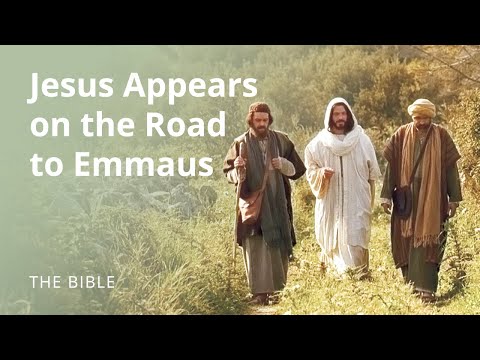
“Jesus Himself came near and went with them.”
The sentence is almost understated.
No dramatic entrance.
No radiant display of glory.
No heavenly announcement.
The Lord of the resurrection simply begins walking.
In the ancient world, roads connected more than cities.
They connected stories.
Travelers shared meals, exchanged news, discussed politics, and interpreted the events shaping their world. Walking together created conversation, and conversation revealed the heart.
Jesus chooses exactly that setting.
He matches their pace.
He enters their sorrow before correcting their understanding.
Perhaps this is one of the Gospel’s most overlooked revelations about the character of Christ.
The risen Lord is in no hurry.
He could have revealed Himself immediately.
He could have silenced every doubt with a single word.
Instead, He asks a question.
“What are you discussing together as you walk?”
It is impossible to believe Jesus lacked information.
Luke has already shown Him as the risen Lord who knows the hearts of His followers.
The question is therefore not for His benefit.
It is for theirs.
Throughout Scripture, God often asks questions whose answers He already knows.
“Where are you?” He asks Adam in the garden.
“What are you doing here, Elijah?” He asks the weary prophet at Horeb.
Questions become invitations.
They draw hidden fears into the light.
Christ does the same on the road to Emmaus.
Before He teaches, He listens.
Before He reveals Himself, He allows grief to speak.
How different this is from our own instincts.
We often rush to solve pain before we have understood it.
Jesus demonstrates another way.
Compassion precedes explanation.
Presence comes before instruction.
The Church Fathers noticed this long ago. Saint Augustine observed that Christ chose to become a fellow traveler before becoming a teacher, reminding believers that divine wisdom often begins with divine companionship. Long before the disciples recognized Jesus, they were already being shepherded by His patient presence.
Eyes That Could Not Yet See
Luke then records one of the most mysterious sentences in the resurrection narratives:
“But their eyes were kept from recognizing Him.”
For centuries, theologians have reflected on this statement.
Was their inability physical?
Psychological?
Spiritual?
Luke offers no simple explanation.
The passive construction—“were kept”—suggests that recognition is withheld until the proper moment within God’s purpose.
This theme appears repeatedly throughout Scripture.
Divine revelation is rarely forced upon people.
It unfolds gradually.
Moses encountered God through a burning bush only after years in the wilderness.
Samuel learned to recognize the Lord’s voice through repeated calling.
The prophets often understood God’s purposes only after long seasons of waiting.
Faith matures not merely by receiving answers but by learning to trust while answers remain hidden.
The Emmaus story belongs to that same pattern.
The disciples are not abandoned.
They are being prepared.
Sometimes God first transforms our understanding before He transforms our circumstances.
Sometimes He walks beside us in silence so that, when our eyes are finally opened, we recognize not only His face but also the quiet faithfulness that accompanied us all along.
That may be the first great lesson of Emmaus.
Christ’s presence is not dependent upon our awareness of Him.
He is no less present when He seems hidden than when He seems near.
The disciples believed they were leaving behind the place where hope had died.
In reality, Hope Himself was already walking beside them.
When the Scriptures Burn Before the Eyes Are Opened
The turning point on the road to Emmaus does not begin with a miracle.
It begins with a rebuke.
To modern ears, Jesus’ first response may sound surprisingly direct.
“O foolish ones, and slow of heart to believe all that the prophets have spoken!”
Yet His words are not spoken in anger.
They are spoken in love.
The Greek expression translated as “slow of heart” reaches far deeper than intellectual misunderstanding. In biblical thought, the heart is not merely the seat of emotion. It is the center of the human person—the place where reason, memory, desire, and faith converge. The disciples did not lack information; they lacked a way of seeing reality through the story God had been telling all along.
Their greatest obstacle was not ignorance.
It was interpretation.
Like many faithful Jews of their generation, they knew the Scriptures. They had heard the Law read in the synagogue. They knew the promises given to Abraham, the songs of David, the visions of Isaiah, and the hopes spoken by the prophets. Yet they expected those promises to unfold according to human assumptions about power and victory.
They anticipated a Messiah who would reign.
God had sent a Messiah who would first suffer.
Their expectations were not completely wrong.
They were simply incomplete.
Beginning with Moses
Luke then records one of the most extraordinary sentences in the entire New Testament.
“Beginning with Moses and all the Prophets, He interpreted to them in all the Scriptures the things concerning Himself.”
What followed remains one of history’s greatest unseen sermons.
Luke never tells us exactly what Jesus said.
Perhaps that silence is intentional.
Rather than preserving a transcript, Luke invites every generation to discover those connections by reading the Scriptures themselves.
Imagine walking beside the risen Christ as He opened the sacred writings.
Perhaps He began in Genesis, where humanity’s fall was immediately followed by God’s promise that the offspring of the woman would ultimately crush the serpent’s head.
Perhaps He spoke of Abraham climbing Mount Moriah with Isaac, where a beloved son carried the wood for his own sacrifice before God provided a ram in his place.
Perhaps He recalled the Passover night in Egypt, when the blood of an innocent lamb marked the homes of God’s people, shielding them from judgment and preparing them for freedom.
He may have turned to the bronze serpent lifted in the wilderness, where those who looked upon what God had provided received life instead of death.
The Psalms would have spoken of the righteous sufferer whose hands and feet were pierced, whose garments were divided, yet whose hope remained firmly in God.
Isaiah’s mysterious Servant would have emerged once more—not as an isolated prophecy but as the culmination of a story that had been unfolding for centuries.
For Jesus, the Scriptures were never a collection of disconnected books.
They were one unified testimony.
The Bible did not merely contain promises about Christ.
Its deepest movement pointed toward Him from beginning to end.
This is one of Luke’s greatest theological contributions.
The resurrection did not create a new story.
It revealed the true meaning of the old one.
When Hearts Burn Before Eyes See
Luke offers one of the most beautiful observations in all of Scripture.
After Jesus disappears from their sight, the disciples look at one another and say,
“Were not our hearts burning within us while He talked to us on the road, while He opened to us the Scriptures?”
Notice the sequence.
Their hearts burned.
Only later did their eyes recognize.
Modern culture often reverses this order.
We assume faith begins when every question has been answered or every mystery explained.
Luke suggests something different.
Faith often begins long before certainty arrives.
The disciples experienced an inward awakening while they still believed the stranger beside them was simply another traveler.
Grace had already begun its quiet work before recognition came.
Early Christian writers frequently reflected on this detail. Saint Gregory the Great observed that Christ first kindled understanding through the Scriptures before revealing His identity, teaching that God’s Word prepares the heart to recognize God’s presence. Divine revelation is not merely about seeing extraordinary things; it is about becoming the kind of person capable of seeing them.
This pattern still shapes the Christian life.
Many believers can identify moments when Scripture suddenly spoke with unusual clarity, when a familiar passage seemed unexpectedly alive, or when hope quietly returned before circumstances changed.
Often, God transforms the heart before He transforms the situation.
The Emmaus road reminds us that spiritual illumination is rarely instantaneous.
Like dawn, it arrives gradually.
Darkness yields to light almost unnoticed until suddenly everything appears different.
The Table Where Recognition Happens
As evening approaches, the disciples urge the stranger to remain with them.
“Stay with us, for it is toward evening and the day is now far spent.”
Hospitality occupied a sacred place in Jewish culture.
Travelers depended upon the kindness of strangers, and welcoming a guest was considered an act of righteousness. Yet Luke subtly reverses expectations.
The disciples believe they are inviting Jesus into their home.
In reality, Christ is preparing to welcome them into a deeper understanding of Himself.
Then comes the moment that has fascinated Christians for centuries.
“He took the bread and blessed and broke it and gave it to them. And their eyes were opened, and they recognized Him.”
Luke’s language is unmistakably familiar.
The same sequence of verbs appears at the feeding of the five thousand.
It echoes the Last Supper.
It would become the pattern remembered every time the early Church gathered to break bread.
Whether Luke intends an explicit reference to the Eucharist has been discussed throughout Christian history. Different Christian traditions have understood this moment in different ways. Yet nearly all agree on one point: recognition comes in an act of fellowship centered upon Christ Himself.
The risen Lord is known not only through information but through communion.
There is another remarkable detail.
The Greek verb translated as “their eyes were opened” recalls language used elsewhere in Scripture when God grants new understanding. The change is not simply visual.
It is spiritual.
Nothing about Jesus’ appearance necessarily changes.
What changes is their perception.
The One who had been beside them all along is finally recognized for who He truly is.
And at that very moment, He vanishes.
To modern readers, this may seem almost disappointing.
Why disappear just when recognition begins?
Because the purpose of the encounter was never merely to prove that Jesus had risen.
It was to teach His followers that His presence would no longer be confined to ordinary sight.
From now on, they would know Him through the witness of Scripture, the fellowship of believers, the breaking of bread, and the ongoing work of the Holy Spirit.
The resurrection was not the restoration of the old relationship.
It was the beginning of a deeper one.
Returning to Jerusalem
The story ends with another journey.
The same road that had carried despair now carries hope.
Without waiting until morning, the disciples immediately return to Jerusalem.
The distance has not changed.
The terrain has not changed.
Only the travelers have changed.
Hours earlier they had walked away convinced that the story was over.
Now they hurry back because they know the story has only just begun.
This reversal reveals one of Luke’s deepest insights.
The resurrection does not simply give believers new information.
It gives them a new way of reading reality.
Jerusalem is no longer the city where hope died.
It has become the place where hope conquered death.
The cross is no longer a symbol of defeat.
It has become the doorway to redemption.
The empty tomb is no longer an unexplained mystery.
It is the beginning of a new creation.
Perhaps this is why the Emmaus narrative has remained one of the Church’s most beloved resurrection stories.
It speaks not only to those who doubt, but also to those who are weary.
To those whose prayers seem unanswered.
To those whose expectations have collapsed beneath the weight of suffering.
The road to Emmaus reminds us that Christ often comes disguised as the companion we least expect.
He listens before He corrects.
He walks before He reveals.
He opens the Scriptures before He opens our eyes.
And long before we recognize His presence, He has already been faithfully walking beside us.
That may be the enduring miracle of Emmaus.
The risen Christ was never waiting at the end of the journey.
He was present in every step of it.
For generations of Christians, this story has offered quiet assurance that even in seasons of confusion, when God seems silent and faith feels fragile, the Lord has not abandoned His people. The One who conquered death is still the One who draws near to discouraged hearts, patiently opening the Scriptures, gently restoring hope, and leading His disciples back toward the place where His redeeming work continues to unfold.