
“God of Earth and Outer Space”: The Most Controversial Hymn Ever Written
▶️ Don't miss this Song of the Day ◀️
In 1970, a Baptist pastor wrote a hymn with words like “astronauts,” “rockets,” and “spacecraft.” It was called either a prophetic masterpiece or the worst hymn in history. Here’s the full story.
At the height of America’s space program, when astronauts were walking on the moon and the future seemed to stretch endlessly into the cosmos, a hymn writer in Houston, Texas, asked a question that no hymn had ever dared to ask: What does faith sound like in outer space?
The Hymn That Divided the Church
In 1970, Thad Roberts Jr., a pastor at South Main Baptist Church in Houston, Texas — the same city where NASA’s Mission Control was located — sat down and wrote a hymn unlike anything the church had ever seen.
It was called “God of Earth and Outer Space.” And it contained words that had never before appeared in a hymnal: astronauts, spacecraft, rockets, outer space, planets.
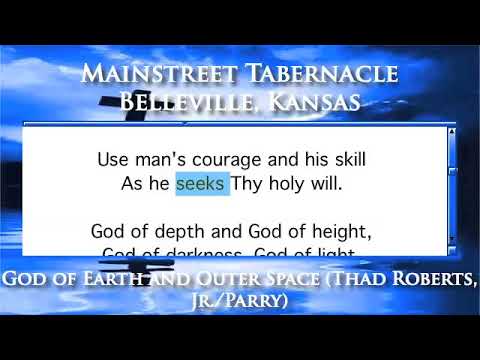
God of earth and outer space,
God of love and God of grace,
Bless the astronauts who fly
As they soar beyond the sky.
God who flung the stars in space,
God who set the sun ablaze,
Fling the spacecraft through the air,
Let man know your presence there.
God of depth and God of height,
God of darkness, God of light,
As man walks in outer space,
Teach him how to walk in grace.
God of power, God of might,
God of rockets firing bright.
Hearts ignite and thrust within,
Love for Christ to share with men.
The hymn was included in the 1975 Baptist Hymnal as number 20 — a position of prominence. And it immediately became one of the most debated hymns in American church history.
“The Worst Hymn Ever Written”?
🔴 The Critics Say
David Bruce Murray, author of Murray’s Encyclopedia of Southern Gospel Music, called it: “The worst hymn ever written — the clear winner.”
Greg Adkins wrote: “It is pretty amazing that someone was able to write a worship song including the words ‘spacecraft,’ ‘rocket,’ ‘astronauts,’ ‘outer space,’ and ‘thrust.'”
Many bloggers and church musicians consider it so bad that it was one of the main reasons the 1975 hymnal was replaced in the early 1990s.
🟢 The Supporters Say
Jonathan Pritchett argues: “Not only should this song be sang more often, but we need more songs that combine themes of faith and science, creation, the sovereignty of God and His love revealed in Jesus Christ.”
Supporters note that Psalm 19 declares “The heavens declare the glory of God” — and this hymn simply extends that ancient truth to the Space Age.
The tune, Aberystwyth by Joseph Parry (1879), is a beautiful Welsh melody that gives the words unexpected gravity.
The Historical Context: When Space Was Sacred
Hymn scholar David Music provides the crucial context: “‘God of Earth and Outer Space’ and two other ‘space’ hymns were written in the late 60s and early 70s — the most vigorous period of America’s space exploration program. After manned space flight began to be de-emphasized, these hymns about space and its exploration quickly fell out of favor.”
The 1970s were a unique moment in history. The Apollo missions had just landed humans on the moon. The entire world watched as astronauts stepped onto another celestial body. For the first time, humanity had to seriously reckon with the theological implications of space travel.
Could God’s presence extend beyond Earth? Was it appropriate to pray for astronauts in the same way believers had prayed for sailors and soldiers for centuries? Did the expansion of human reach into the cosmos require a new kind of worship?
Thad Roberts Jr. believed the answer was yes.
There Was Another Space Hymn
Few people know that the 1975 Baptist Hymnal contained a secondhymn about space: “Declare, O Heavens, the Lord of Space”, set to the tune of All Creatures of Our God and King. The second verse begins:
Launch forth, O man, and boldly rise,
Beyond our planet pierce the skies,
Boundless venture! Alleluia!
And in the Book of Worship for United States Forces (1974), there appears yet another:
Bless Thou the astronauts who face
The vast immensities of space;
And may they know, in air, on land,
Thou holdest them within Thy hand.
These hymns reveal something profound: in moments when humanity pushes beyond known boundaries, the instinct to turn to God in worship does not diminish — it intensifies.
The problem isn’t that the hymn mentions rockets. The problem is that we’re uncomfortable acknowledging that God’s sovereignty extends to wherever human beings are brave enough to go.
The Theological Question Behind the Controversy
Why does this hymn provoke such strong reactions? Partly, it’s the language — “thrust” and “rockets” feel jarring in a worship context. Partly, it’s the association with a particular era that many would rather forget.
But at a deeper level, the controversy reveals an unresolved tension in modern Christianity: Is God relevant to the frontier of human knowledge? Or is faith something we retreat to when science has nothing left to say?
Thad Roberts Jr. took the position that God is not confined to the familiar. If humans walk on the moon, God walks with them. If rockets fire in the void, God’s presence fills the void. This is not a diminishment of faith — it is an expansion of it.
A Hymn Ahead of Its Time?
In 2025, NASA’s Artemis program is returning humans to the moon. SpaceX is planning missions to Mars. China has a permanent space station. The commercial space industry is booming. Humanity is, once again, reaching for the stars.
Perhaps it’s time to reconsider a hymn that asked, fifty years ago, what so many of us are only now beginning to think about.
THE DEEPER QUESTION
“God of Earth and Outer Space” may be awkward. Its vocabulary may be dated. Its imagery may feel borrowed from a science fiction novel. But its core instinct — that God’s presence is not limited by the boundaries of our experience — is one of the most profoundly biblical ideas in all of Scripture. Paul wrote that in God “we live and move and have our being” (Acts 17:28). If that is true, then no distance we travel, no frontier we cross, and no void we enter is beyond the reach of grace. Perhaps the hymn was never the problem. Perhaps the problem was our willingness to limit God to the world we already understand.