



O, how I love Jesus!
▶️ Don't miss this Song of the Day ◀️
There are hymns that impress us with their poetry, and there are hymns that remain with us because they give ordinary believers words for a truth they already carry in their hearts. “O How I Love Jesus” does both.
Its language is simple, its melody is easy to remember, and its refrain can be sung by a child. Yet beneath that simplicity lies a rich message about the name of Jesus, the saving work of Christ, the comfort of God, and the grace that always takes the first step toward us.
The final line explains why this hymn has endured:
“Because He first loved me.”
That sentence turns the song from a declaration of human devotion into a confession of divine grace. Christians love Jesus not to earn His love, but because His love has already been revealed in His life, death, resurrection, and continuing care.
O How I Love Jesus Lyrics
The words of the hymn were written by Frederick Whitfield (1829–1904). Whitfield’s original text contained nine stanzas, although modern hymnals usually print only a selection. The following version includes the commonly sung stanzas and refrain:
1. There is a name I love to hear,
I love to sing its worth;
It sounds like music in my ear,
The sweetest name on earth.Refrain:
O how I love Jesus,
O how I love Jesus,
O how I love Jesus,
Because He first loved me!2. It tells me of a Savior’s love,
Who died to set me free;
It tells me of His precious blood,
The sinner’s perfect plea.3. It tells me what my Father hath
In store for every day,
And though I tread a darksome path,
Yields sunshine all the way.4. It tells of One whose loving heart
Can feel my deepest woe;
Who in each sorrow bears a part
That none can bear below.
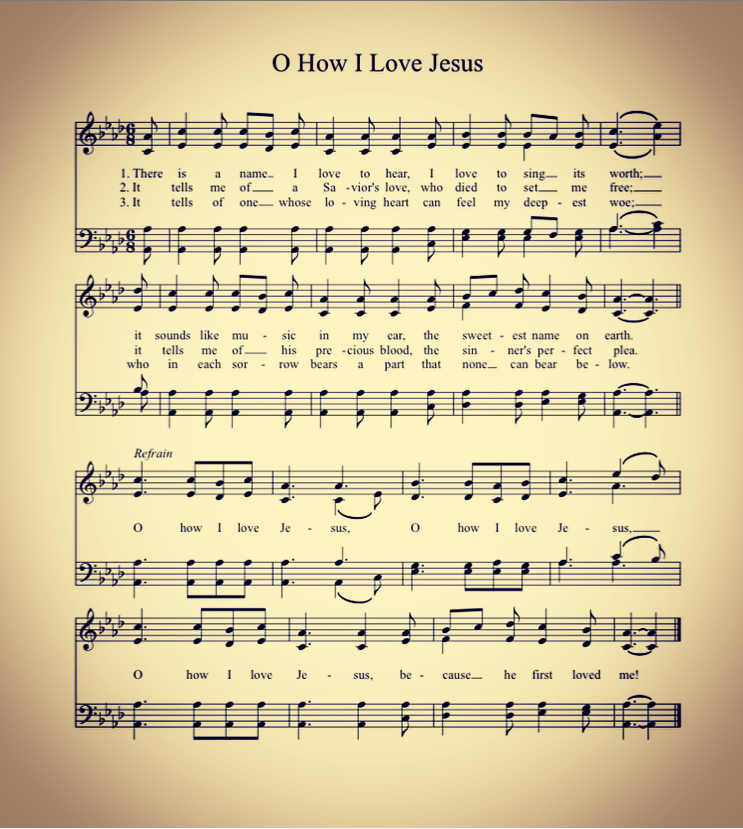
Wording and stanza selection vary among hymnals. The historic words and traditional melody are generally identified as public domain, but a modern arrangement, recording, translation, or edited edition may have its own copyright.
Who Wrote O How I Love Jesus?
Frederick Whitfield, an English Anglican minister and writer, wrote the text in 1855. It first circulated under the title “The Name of Jesus” and later appeared in Whitfield’s Sacred Poems and Prose in 1861.
Whitfield was born in Shropshire, England, studied at Trinity College Dublin, and served in several Church of England appointments. He also published numerous volumes of prose and poetry. Of all his writing, this direct and personal hymn became his best-known work.
The text originally consisted of nine stanzas. Most congregations today sing three or four, commonly choosing the verses about:
- the sweetness of Jesus’ name;
- the Savior’s sacrificial love;
- the Father’s daily care; and
- Christ’s compassion in sorrow.
The familiar tune is generally described as a traditional nineteenth-century American melody associated with the camp-meeting tradition. The refrain was not part of Whitfield’s original poem and was likely joined to it later. In nineteenth-century revivals, memorable refrains sometimes traveled between hymns, helping large gatherings participate even when printed songbooks were unavailable.
This combination—an English devotional text, an American folk-like melody, and a repeated gospel refrain—gave the hymn its distinctive character.
What Does O How I Love Jesus Mean?
At first glance, the hymn appears to be about the believer’s love for Jesus. Its deeper subject, however, is why Jesus is worthy of that love.
Each stanza begins with what the name of Jesus “tells” the singer. His name is not treated as a sound or label. It represents who He is and what He has done: Savior, Redeemer, faithful companion, and compassionate Lord.
1. The name points to the person
The opening stanza calls Jesus’ name “the sweetest name on earth.” In the Bible, a name often carries meaning connected to identity and character. Matthew 1:21 links the name Jesus with His saving mission: He will save His people from their sins.
The hymn therefore does not invite empty repetition. To sing the name of Jesus is to remember the person of Jesus—His holiness, mercy, authority, and love.
Philippians 2:9–11 gives this theme a larger horizon. God highly exalts Christ so that every knee will bow and every tongue confess that Jesus Christ is Lord. Whitfield turns that great confession into personal worship: the name honored throughout creation is also the name the believer loves to hear.
2. Christian love begins with Christ’s love
The refrain closely echoes 1 John 4:19:
“We love because he first loved us.”
This is the theological center of the hymn. The order matters. Jesus’ love comes first; our love answers it.
That truth protects Christian devotion from two common errors. First, it keeps faith from becoming an attempt to earn God’s acceptance. Second, it keeps worship from becoming mere emotion. The believer’s affection is grounded in an objective act of grace: Christ loved sinners and gave Himself for them.
The refrain is not spiritual self-congratulation. It is gratitude.
3. The cross gives the name its saving sweetness
The second stanza moves from the sound of Jesus’ name to the reason it is precious:
“It tells me of a Savior’s love,
Who died to set me free.”
The phrase “His precious blood” points to Christ’s sacrificial death. In Christian teaching, forgiveness does not rest on human merit but on what Jesus accomplished at the cross. His death becomes “the sinner’s perfect plea”—the believer’s confidence is not “I have done enough,” but “Christ has done what I could not do.”
This is why the hymn’s tenderness should not be mistaken for sentimentality. Its emotional warmth grows from a clear gospel claim: the Savior gave Himself to bring freedom and reconciliation.
4. Jesus meets people in real sorrow
Another widely sung stanza speaks of Christ’s loving heart, which can feel our “deepest woe.” The hymn does not deny pain or promise an effortless life. It presents Jesus as One who enters human sorrow with compassion.
Hebrews 4:15–16 describes Christ as a high priest who can sympathize with human weakness. Believers may therefore approach God’s throne of grace with confidence and seek mercy in time of need.
This gives the hymn enduring pastoral value. It can be sung in joyful worship, but it can also accompany grief, loneliness, illness, uncertainty, or fear. Its message is not that faithful people never suffer; it is that suffering people are not abandoned.
Bible Verses Behind O How I Love Jesus
The hymn’s ideas connect naturally with several passages of Scripture:
- 1 John 4:19 — Our love is a response to God’s prior love.
- Matthew 1:21 — Jesus’ name is connected with His mission to save.
- Philippians 2:9–11 — Every knee will bow at the name of Jesus.
- Acts 4:12 — Salvation is found in no other name.
- Romans 5:8 — God demonstrates His love through Christ’s death for sinners.
- Ephesians 1:7 — Redemption and forgiveness come through Christ’s blood.
- Hebrews 4:15–16 — Jesus sympathizes with human weakness and welcomes people to grace.
- Romans 8:38–39 — Nothing can separate believers from the love of God in Christ.
These references can be used for personal study, a small-group discussion, a sermon, or a short devotional before the hymn is sung.
Why This Hymn Still Matters
Many songs become closely tied to the style of the period that produced them. “O How I Love Jesus” has lasted because its central message is not dependent on a trend.
It makes deep truth singable
“Because He first loved me” summarizes a central Christian conviction in six words. The line is simple enough to remember and deep enough to revisit throughout a lifetime.
It joins doctrine and affection
The hymn does not ask singers to choose between knowing truth and loving Christ. It holds both together. The cross explains the affection; grace produces the response.
It is accessible across generations
The repeated refrain and gentle movement of the traditional 6/8 melody make the song easy for a congregation to learn. Children, new believers, and experienced worshipers can sing it together without needing a complicated arrangement.
It speaks to both celebration and pain
The hymn expresses joy, but it also recognizes the “darksome path” and “deepest woe.” That emotional honesty allows it to serve in Sunday worship, family singing, pastoral care, funerals, prayer meetings, and private devotion.
How to Use O How I Love Jesus in Worship
A familiar hymn can become routine unless leaders help the congregation notice what it is saying. These practices can restore attention without overexplaining the song.
Read 1 John 4:19 before singing
A single verse gives the refrain its biblical context. Emphasize that worship is a response to grace, not a way to persuade God to love us.
Let the arrangement serve the words
The song works with piano, organ, guitar, a cappella voices, or a small acoustic ensemble. A restrained first verse can make room for reflection; additional voices or harmony can then enter as the text unfolds.
Use a less familiar stanza
If your hymnal or licensing arrangement permits it, include a stanza about daily providence or Christ’s compassion in sorrow. This can help the congregation hear the hymn afresh.
Pair it with a testimony or prayer
Invite worshipers to consider one concrete way Christ’s love has met them. Follow the hymn with a prayer of gratitude for salvation, daily care, and comfort in suffering.
Avoid rushing the refrain
Repetition is most meaningful when each line is sung as a genuine confession. A natural tempo allows the final reason—“Because He first loved me”—to carry its full weight.
A Short Devotional: Love That Comes First
It is easy to measure our spiritual life by the intensity of our feelings. Some days love for Christ seems strong; on other days it feels quiet or clouded by fatigue, grief, distraction, or doubt.
“O How I Love Jesus” redirects our attention. Its refrain begins with our confession, but it ends with the foundation beneath it: He first loved me.
The security of faith does not rest on maintaining a constant emotional state. It rests on the steadfast love of Christ. The cross is evidence that His love is more than a passing feeling. His compassion in sorrow shows that His care is not limited to our best days.
When you sing this hymn, you do not have to pretend that your love is perfect. You can bring Christ a real but incomplete response, trusting that His love came before yours, awakens yours, and continues to sustain it.
Prayer: Lord Jesus, thank You for loving me first. Help me to know the worth of Your name, rest in Your saving work, and trust Your heart in every sorrow. Let my words, choices, and worship become a grateful response to Your grace. Amen.
Frequently Asked Questions
Who wrote O How I Love Jesus?
Frederick Whitfield, a nineteenth-century English Anglican minister and writer, wrote the hymn text in 1855. It was originally known as “The Name of Jesus.”
Who composed the tune?
The tune most commonly used today is generally identified as a traditional or anonymous nineteenth-century American melody connected with camp-meeting worship. The familiar refrain was likely added to Whitfield’s text later.
What is the main Bible verse behind the hymn?
The refrain is based on 1 John 4:19: “We love because he first loved us.” The hymn also reflects biblical teaching about Jesus’ name, saving death, and compassion.
What is the meaning of “the sinner’s perfect plea”?
The phrase means that a sinner’s hope of forgiveness rests on Christ’s sacrifice rather than personal goodness. Jesus’ saving work—not human achievement—is the basis for approaching God with confidence.
Is O How I Love Jesus in the public domain?
The historic English text and traditional tune are widely listed as public domain. However, newly created arrangements, recordings, translations, typesetting, and edited versions may still be protected. Check the rights attached to the specific version you plan to publish, perform, or record.
How many original stanzas are there?
Whitfield’s original poem contained nine stanzas. Modern hymnals commonly include only three or four, and the exact selection varies.
Final Reflection
“O How I Love Jesus” has survived not because it says everything that can be said about Christian faith, but because it says one essential thing with unusual clarity: love for Christ begins with the love of Christ.
The verses give the name of Jesus its content. He is the Savior who dies to set sinners free, the Lord whose heart understands sorrow, and the faithful One whose care reaches into the unknown path ahead. The refrain then gives the worshiper a response—simple, personal, and grounded in grace.
That is why this nineteenth-century hymn still belongs in the church’s song today. It helps believers remember that before they sought Christ, sang to Christ, or loved Christ, they were already the objects of His gracious love.