

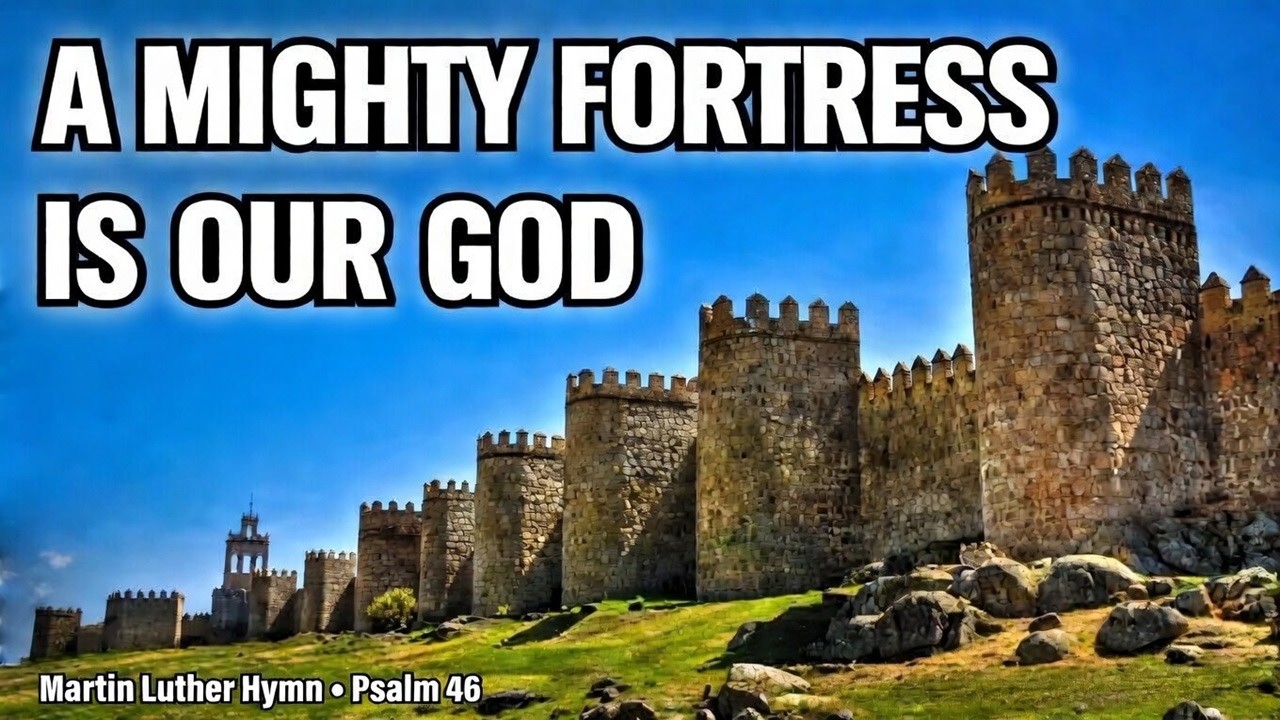
A Mighty Fortress Is Our God
▶️ Don't miss this Song of the Day ◀️
A Mighty Fortress Is Our God – The Powerful Story Behind Martin Luther’s Hymn of Unshakable Faith
Few hymns have shaped Christian history as profoundly as “A Mighty Fortress Is Our God.” For nearly five centuries, its triumphant melody and unwavering message have strengthened believers through persecution, uncertainty, war, and personal trials. More than a hymn, it became the anthem of the Protestant Reformation—a declaration that God’s protection is stronger than any earthly power.
Often called “the Battle Hymn of the Reformation,” this timeless song continues to inspire millions of Christians around the world. Behind its stirring words lies an extraordinary story of courage, conviction, and unwavering trust in God during one of the most turbulent periods in church history.
Basic Information
- Title: A Mighty Fortress Is Our God
- Original German Title: Ein feste Burg ist unser Gott
- Author: Martin Luther
- Written: Around 1527–1529
- Language: German
- Biblical Inspiration: Psalm 46
- Theme: God’s protection, spiritual warfare, faith, victory in Christ
- Commonly Called: The Battle Hymn of the Reformation
The World Martin Luther Lived In
To understand this hymn, it is important to understand the world in which it was written.
The early sixteenth century was a time of enormous religious and political upheaval. The Western Church was divided by controversy over authority, doctrine, and practices. Many ordinary Christians longed for a clearer understanding of Scripture and the message of salvation.
In 1517, Martin Luther, an Augustinian monk and professor of theology in Wittenberg, challenged certain church practices by publishing his famous Ninety-five Theses. Although intended to spark theological discussion, the document quickly spread throughout Europe thanks to the newly invented printing press.
The events that followed transformed Christian history.
Luther was summoned before church authorities, declared an outlaw by the Holy Roman Empire after the Diet of Worms (1521), and lived for a period under the protection of Elector Frederick the Wise at Wartburg Castle. During this time, he translated the New Testament into German, making Scripture accessible to ordinary people.
The years that followed were marked by intense conflict. Religious debates, political tensions, peasant revolts, and threats from external enemies created an atmosphere of uncertainty throughout Europe.
Against this backdrop, Luther did not write a hymn of fear—but one of confidence.
Inspired by Psalm 46
The foundation of A Mighty Fortress Is Our God is Psalm 46, one of the Bible’s greatest declarations of confidence in God.
The psalm opens with these familiar words:
“God is our refuge and strength, an ever-present help in trouble.”
Psalm 46 describes a world filled with chaos:
- Mountains shaking
- Nations raging
- Kingdoms falling
- Wars spreading across the earth
Yet in the midst of turmoil comes the unforgettable assurance:
“Be still, and know that I am God.”
Luther saw in this psalm a timeless promise. Political powers rise and fall. Human institutions change. Evil may seem powerful for a time. But God remains an unshakable refuge for His people.
Rather than paraphrasing Psalm 46 word for word, Luther transformed its themes into a congregational hymn that ordinary believers could sing together.
Lyrics:

Why Luther Wrote the Hymn
Historians cannot identify one single event that inspired the hymn. Instead, many scholars believe it grew out of several hardships Luther experienced during the late 1520s.
During these years, Europe faced:
- Religious persecution
- Political instability
- Military threats
- Outbreaks of plague
- Personal grief and loss
- Constant criticism directed at Luther and other Reformers
Despite these pressures, Luther remained convinced that the greatest battle facing Christians was not political but spiritual.
He believed believers should place their confidence not in armies, governments, or human strength, but in God’s Word and the victory of Jesus Christ.
This conviction echoes throughout every verse of the hymn.
A Hymn Born During Difficult Days
One of the most moving aspects of this hymn is that it was not written during a season of peace.
Luther had every earthly reason to be discouraged.
He had been condemned by powerful authorities. Friends and fellow Reformers faced danger. Europe was unsettled, and disease was never far away.
Yet his response was not despair.
Instead, he wrote about God’s sovereignty.
The opening words immediately establish the hymn’s central image:
“A mighty fortress is our God.”
A fortress in Luther’s day was not merely a symbolic building. It represented safety, protection, and hope during times of attack. When enemies surrounded a city, people fled behind the thick stone walls of a fortress.
Luther reminds believers that God Himself is our refuge—stronger than any castle ever built.
The Meaning Behind the Hymn
God Is Our Fortress
The fortress represents complete security.
Human strength eventually fails.
Governments change.
Nations rise and fall.
But God’s protection never weakens.
The hymn teaches believers to place their confidence in God’s eternal character rather than temporary circumstances.
Spiritual Warfare Is Real
Unlike many patriotic songs of later centuries, Luther’s hymn focuses primarily on the spiritual struggle between good and evil.
The enemy described in the hymn is not another nation.
It is Satan, whom Luther portrays as powerful yet ultimately defeated through Christ.
This reflects biblical teaching found in passages such as Ephesians 6, where Christians are encouraged to “put on the whole armor of God.”
Christ Has Already Won
One of the hymn’s most comforting themes is victory.
Although evil exists, Luther emphasizes that Christ has already secured the final triumph.
Believers do not fight for victory.
They stand in the victory Christ has already accomplished through His death and resurrection.
God’s Word Cannot Be Defeated
Throughout the Reformation, Luther believed Scripture held ultimate authority.
The hymn repeatedly celebrates the enduring power of God’s Word.
Empires may attempt to silence it.
Opposition may arise.
But God’s truth continues to endure from generation to generation.
Music That Invited the Whole Church to Sing
Before the Reformation, much of church music was performed by trained choirs or clergy. Congregational singing was limited in many places.
Martin Luther believed every believer should actively participate in worship through song.
He therefore encouraged hymns written in the language of ordinary people rather than only in Latin.
“A Mighty Fortress Is Our God” became one of the earliest and most influential examples of congregational hymn singing.
Families sang it at home.
Churches sang it during worship.
Students learned it in schools.
Over time, it became deeply woven into Protestant worship traditions around the world.
Why It Became Known as “The Battle Hymn of the Reformation”
The hymn’s bold language and confident tone resonated with those who supported the Reformation. It came to symbolize steadfast faith in God’s truth during a period of intense religious change.
Its “battle” imagery was understood primarily as a picture of spiritual conflict rather than a call to military action. Luther’s emphasis remained on trusting God’s power rather than relying on human force.
As the hymn spread across Europe, it became a musical expression of hope, courage, and confidence in God’s sovereignty.
Influence on Christian Worship
Over the centuries, A Mighty Fortress Is Our God has become one of the most frequently sung hymns in Protestant churches.
It is commonly included in:
- Reformation Sunday services
- Church anniversaries
- Ordinations
- Mission conferences
- Bible conferences
- Memorial services
- Times of national prayer and reflection
The hymn has also inspired countless musical arrangements by composers including Johann Sebastian Bach, whose settings helped preserve and expand its influence.
Why This Hymn Still Speaks Today
The world Luther knew was marked by uncertainty. In many ways, ours is too.
People today face different challenges—illness, conflict, economic hardship, loneliness, anxiety, and rapidly changing societies. While the circumstances differ, the need for a dependable refuge remains the same.
This hymn gently redirects our attention away from fear and toward God’s unchanging faithfulness. It reminds us that our ultimate security does not rest in wealth, influence, or human achievement, but in the Lord who remains steadfast through every generation.
Its message is not one of denial or false optimism. Instead, it acknowledges that struggles are real while affirming that God’s presence is greater than every storm.
A Reflection for Today
There are moments when life feels uncertain and the future seems impossible to predict. Plans change, fears grow, and the world around us can appear unstable.
In those moments, the image of God as a mighty fortress becomes deeply personal. A fortress does not remove every battle, but it provides a place of refuge in the midst of them.
Perhaps that is why this hymn has endured for nearly five hundred years. It does not promise an easy path. It points us to a faithful God whose strength does not fail.
Generation after generation, believers have found courage in its words—not because they trusted in themselves, but because they trusted in the One who is forever their refuge.
Legacy
Nearly five centuries after Martin Luther first wrote A Mighty Fortress Is Our God, the hymn continues to be sung in churches across the world.
Its enduring legacy is found not only in its historical importance during the Reformation but also in its timeless message. It proclaims that God’s kingdom stands firm, His Word endures, and His people can face every season with hope because Christ has already won the victory.
More than a historic hymn, it remains a living testimony of faith—inviting every generation to stand confidently in the shelter of the God who is, and always will be, our mighty fortress.