

O for a Thousand Tongues to Sing
▶️ Don't miss this Song of the Day ◀️
O for a Thousand Tongues to Sing – The Inspiring Story Behind One of Christianity’s Most Joyful Hymns
Among the great hymns of the eighteenth century, few express the joy of salvation as beautifully as “O for a Thousand Tongues to Sing.” For more than 280 years, Christians around the world have sung these words with grateful hearts, celebrating the transforming power of Jesus Christ. The hymn is filled with praise, but behind its joyful melody lies a deeply personal story of spiritual renewal, answered prayer, and a life forever changed by God’s grace.
Written by Charles Wesley (1707–1788), one of history’s most influential hymn writers, this beloved hymn has become a cornerstone of Christian worship. It continues to remind believers that no single human voice seems sufficient to praise the greatness of Christ.
Basic Information
Title: O for a Thousand Tongues to Sing
Author: Charles Wesley
Written: 1739
First Published: Hymns and Sacred Poems (1739)
Biblical Themes: Salvation, redemption, praise, the power of Christ’s name, new life in Christ
Common Tune: AZMON (most widely used today)
The Story Behind the Hymn
Unlike many hymns that were inspired by a single dramatic event, O for a Thousand Tongues to Sing grew out of one of the most significant spiritual experiences in Charles Wesley’s life.
In the spring of 1738, Charles Wesley was seriously ill in London. Physically weak and spiritually discouraged, he questioned whether he truly possessed the assurance of God’s forgiveness. Although he had devoted his life to religious work, he struggled to experience the peace that Scripture promised.
On May 21, 1738, everything changed.
After weeks of prayer, reading Scripture, and conversations with Christian friends, Charles Wesley experienced a profound assurance that Christ had forgiven his sins. He later described this moment as one in which he came to rest completely in God’s grace rather than in his own efforts.
That day became one of the defining moments of his life.
Just three days later, his older brother John Wesley experienced his own famous spiritual awakening at a meeting on Aldersgate Street. Together, the two brothers would become leading figures in the evangelical revival that spread throughout Britain and eventually around the world.
One year after his own conversion experience, Charles celebrated the anniversary by writing a hymn of overflowing gratitude. That hymn became “O for a Thousand Tongues to Sing.”
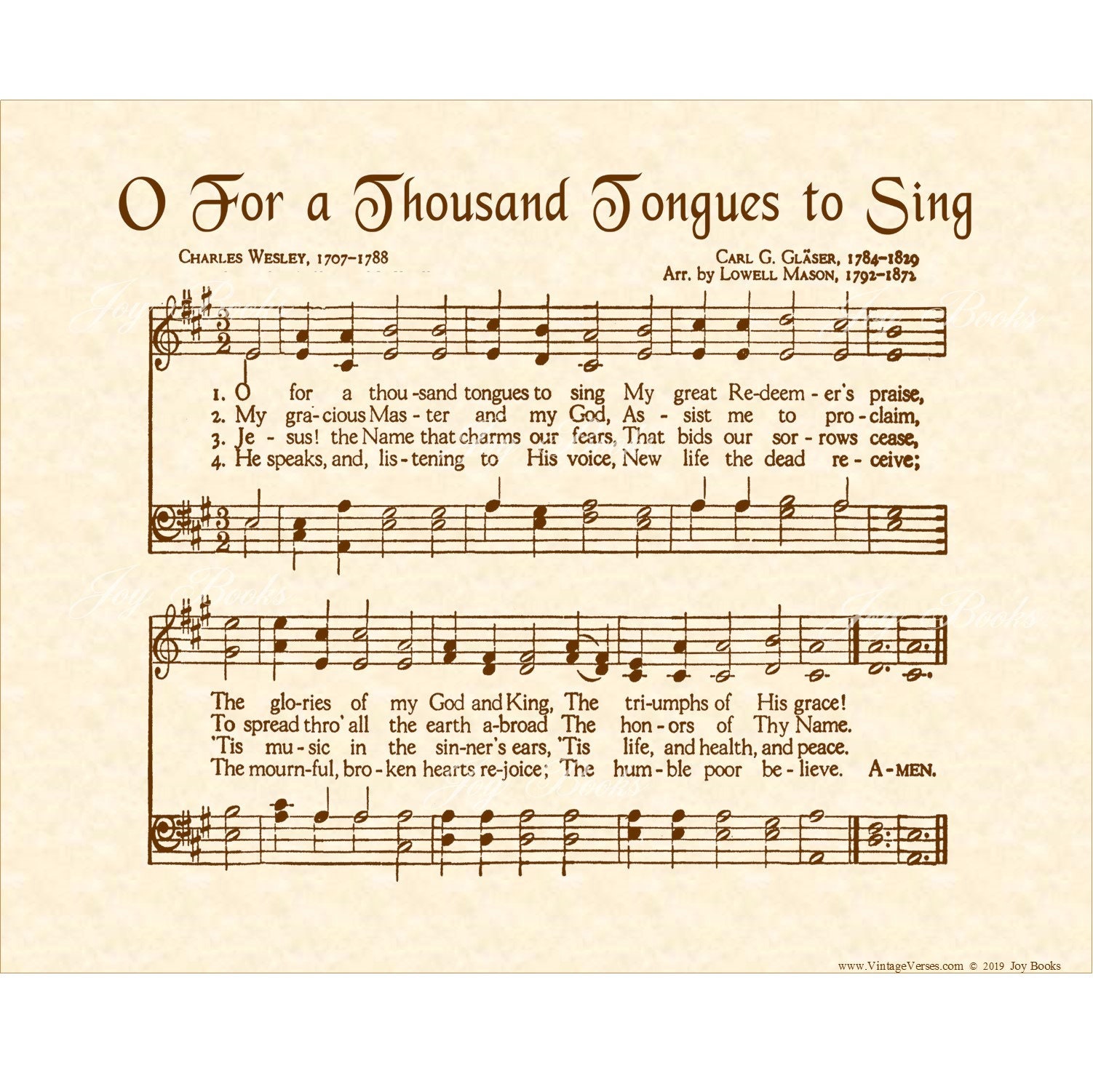
Lyrics:
1 O for a thousand tongues to sing
my great Redeemer’s praise,
the glories of my God and King,
the triumphs of his grace!
2 My gracious Master and my God,
assist me to proclaim,
to spread thro’ all the earth abroad
the honors of your name.
3 Jesus! the name that charms our fears,
that bids our sorrows cease,
’tis music in the sinner’s ears,
’tis life and health and peace.
4 He breaks the power of cancelled sin,
he sets the prisoner free;
his blood can make the foulest clean;
his blood availed for me.
5 To God all glory, praise, and love
be now and ever given
by saints below and saints above,
the Church in earth and heaven.
Inspired by a Simple Conversation
One fascinating detail behind the hymn comes from a Moravian Christian named Peter Böhler, who had greatly influenced both Charles and John Wesley.
According to tradition, Böhler once encouraged Charles with these memorable words:
“Had I a thousand tongues, I would praise Christ with them all.”
The thought remained with Charles long after the conversation ended.
When he later reflected on God’s saving grace, those words returned to his heart. He transformed the idea into one of the most famous opening lines in hymn history:
“O for a thousand tongues to sing my great Redeemer’s praise.”
The phrase is not a literal wish for more voices. Instead, it expresses the feeling that one human voice is simply not enough to thank Christ for His mercy.
The Methodist Revival and Congregational Singing
The hymn was born during the early years of the Methodist Revival, a movement that transformed Christian worship in eighteenth-century England.
At that time, many churches relied heavily on formal liturgy, and congregational singing was often limited. Charles Wesley believed that hymns could help ordinary people understand Scripture, remember biblical truth, and express their faith in everyday language.
Over his lifetime, he wrote more than 6,000 hymns, making him one of the most prolific hymn writers in Christian history.
His hymns were not merely songs. They served as sermons set to music, teaching theology through memorable poetry that could be sung by farmers, laborers, merchants, and families alike.
Among all his works, O for a Thousand Tongues to Sing quickly became one of the best loved.
Why the Hymn Begins with “A Thousand Tongues”
The opening line immediately captures the imagination.
No one literally needs a thousand tongues.
Charles Wesley uses poetic language to express a truth that many believers understand: when someone experiences God’s grace deeply, ordinary words often feel inadequate.
Every act of forgiveness, every answered prayer, every moment of mercy becomes another reason to praise Christ.
The image of “a thousand tongues” symbolizes praise without limits—a desire that every language, every nation, and every generation would glorify the Savior.
The Meaning Behind the Hymn
One of the hymn’s greatest strengths is the way it unfolds the message of the Gospel through praise.
Rather than focusing on human achievement, Charles Wesley directs every line toward Jesus Christ and His saving work.
The hymn celebrates Christ as the Redeemer who forgives sin, heals broken hearts, frees those bound by guilt, and gives hope to people who once lived in spiritual darkness.
Its message echoes passages such as Isaiah 61, Luke 4, and Revelation 5, where God’s salvation brings freedom, healing, and joyful worship.
The hymn also reflects the biblical conviction that praise is the natural response to grace. Christians do not sing to earn God’s favor; they sing because they have already received it.
Why It Has Endured for Nearly Three Centuries
Many hymns become closely associated with one generation.
O for a Thousand Tongues to Sing has continued to inspire believers because its central message never grows old.
Every generation experiences the need for forgiveness.
Every generation longs for hope.
Every generation discovers that Christ remains faithful.
Whether sung by a small congregation in a village chapel or by thousands gathered in a cathedral, the hymn continues to unite believers in joyful worship.
Its language is poetic, yet its message is simple enough for children to understand and profound enough for theologians to appreciate.
Influence Around the World
As Methodism spread across Britain, North America, Africa, Asia, and many other regions, O for a Thousand Tongues to Sing traveled with it.
Today, it appears in countless hymnals representing Methodist, Anglican, Presbyterian, Baptist, Lutheran, and many other Christian traditions.
It has been translated into numerous languages, allowing believers from different cultures to share in the same song of praise.
Many churches choose this hymn for Easter celebrations, church anniversaries, ordination services, revival meetings, and occasions that emphasize the joy of salvation.
Its enduring popularity reflects not only its beautiful poetry but also its unwavering focus on Christ.
A Reflection for Today
There are moments when gratitude is difficult to express. We look back on God’s faithfulness through answered prayers, unexpected provision, restored relationships, or quiet strength during painful seasons, and words seem too small.
That is the feeling Charles Wesley captured so beautifully.
His longing for “a thousand tongues” reminds us that worship is not measured by the volume of our voices but by the sincerity of our hearts. Even the simplest prayer of thanksgiving rises as a precious offering to God.
Nearly three centuries later, this hymn still invites us to pause and remember that every redeemed life has a story worth singing. It encourages us to lift our voices—not because life is always easy, but because Christ remains worthy of praise in every season.
Legacy
More than 280 years after Charles Wesley wrote O for a Thousand Tongues to Sing, the hymn continues to echo through churches around the world.
Its lasting influence is rooted not only in its literary beauty but in the life-changing experience that inspired it. A hymn born from one man’s gratitude has become the shared testimony of millions of believers across generations.
Its message remains as powerful today as it was in 1739: no matter how many voices we possess, they will never fully express the greatness of our Redeemer. Yet every song of praise, offered with faith and gratitude, joins the unending chorus that glorifies Christ forever.