


Pass Me Not, O Gentle Savior: A Cry from the Heart for Divine Notice
▶️ Don't miss this Song of the Day ◀️
“Pass me not, O gentle Savior, hear my humble cry; while on others Thou art calling, do not pass me by.”
In the quiet, reflective moments of a believer’s life, there are times when we feel small, overlooked, or spiritually adrift. It is in these moments of vulnerability that the hymn Pass Me Not, O Gentle Savior finds its power. Written by the incomparable Fanny Crosby in 1868, this hymn is not merely a song of worship; it is a raw, honest, and deeply poignant petition for the gaze of the Almighty. It serves as a bridge between the feeling of human insignificance and the overwhelming reality of divine grace.
The Origin: A Humble Request in a Time of Revival
To understand the emotional depth of Pass Me Not, O Gentle Savior, one must look at the setting of its creation. Fanny Crosby was visiting a prison in New York, ministering to the inmates. As she listened to the men pray and heard them express their deep desire not to be forgotten by God, she was moved to tears.
Upon returning home, the melody and the words began to take shape in her heart. She was struck by a profound theological realization: while God’s grace is infinite and extended to the masses, the human heart often needs to know that it is seen individually. The “Gentle Savior” is not a distant deity, but one who pauses to hear the “humble cry” of the one who feels lost in the crowd.
The Theology of “Being Seen”
At the core of this hymn is a tension familiar to every seeker of faith. We acknowledge that God is sovereign and all-knowing, yet we feel the human need for a personal encounter.
1. The Fear of Being Overlooked
“While on others Thou art calling, do not pass me by.” This line captures the universal human fear of being forgotten. In a busy, loud, and demanding world, it is easy to feel that our struggles are invisible. Crosby’s prayer is a plea for intimacy—a request for the Savior to turn His eyes toward the individual soul, just as He did for the woman who touched the hem of His garment in the crowd.
2. The Throne of Grace
“Let me at Thy throne of mercy find a sweet relief; kneeling there in deep contrition, help my unbelief.” The hymn moves from a cry for attention to a posture of humility. By moving to the “throne of mercy,” the speaker finds a place of safety. Here, the struggle is not just about being “seen,” but about being “transformed.” The mention of “helping my unbelief” is a refreshingly honest confession—acknowledging that even in our prayer, we often struggle to fully trust.
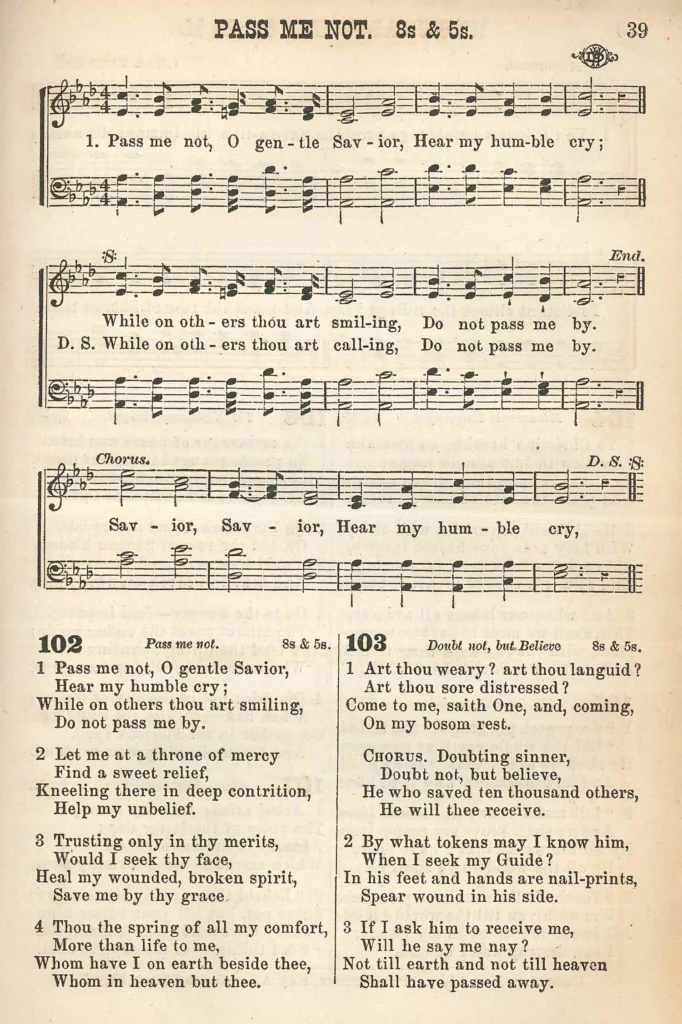
Lyrics:
| Pass me not, O gentle Savior Hear my humble cry While on others Thou art calling Do not pass me by Savior, Savior Hear my humble cry While on others Thou art calling Do not pass me by Let me at Thy throne of mercy Find a sweet relief Kneeling there in deep contrition Help my unbelief Savior, Savior Hear my humble cry While on others Thou art calling Do not pass me by Trusting only in Thy merit Would I seek Thy face Heal my wounded, broken spirit Save me by Thy grace Savior, Savior Hear my humble cry While on others Thou art calling Do not pass me by Thou the spring of all my comfort More than life to me Whom have I on earth beside Thee? Whom in Heav’n but Thee? Savior, Savior Hear my humble cry While on others Thou art calling Do not pass me by While on others Thou art calling Do not pass me by |
Finding “Sweet Relief” in Our Brokenness
The hymn does not promise that life will be without pain. In fact, it explicitly mentions a “wounded, broken spirit.” This is where the beauty of Pass Me Not truly shines—it invites us to bring our brokenness to the Savior.
In our modern era, we often feel the pressure to present a “perfected” version of ourselves to God. We pray when we are strong, or we hide when we are weak. This hymn teaches us the opposite: that the throne of mercy is meant specifically for the broken. When we kneel in “deep contrition,” we are not performing a religious act; we are entering into the most sacred form of honesty.
Living the Hymn Today: Practical Reflections
How can we embody the prayer of Pass Me Not in our daily lives?
- Practice Honest Prayer: Next time you pray, stop trying to use “proper” religious language. Tell God exactly where you feel invisible, where you feel weak, or where your faith is struggling. He already knows—your vocalizing it is the act of “kneeling at the throne.”
- Focus on the “Spring of Comfort”: In a world of superficial distractions, identify what your “spring” is. Are you looking for comfort in success, relationships, or possessions? Crosby challenges us to shift that focus: “Thou the Spring of all my comfort, more than life to me.”
- Embrace the Grace of the Individual: Remember that you are not a statistic to God. The Savior who called out to Zacchaeus in the tree and recognized Peter by the fire is the same Savior who is calling your name today.
A Melody of Belonging
Pass Me Not, O Gentle Savior remains a pillar of our faith because it gives voice to our deepest insecurity and meets it with the highest promise: that we are seen, we are known, and we are held by the One who loves us most.
As you navigate the challenges of your week, let this hymn be your companion. When the world feels too large or your spirit feels too small, remember the chorus. Your cry is not lost in the wind; it reaches the ears of the Savior who never passes by the heart that truly seeks Him.